Application Lifecycle Management (ALM) Solutions

ALM as the Foundation of Connected Product Development
ALM is the backbone of modern product development. It connects requirements, design, development, testing, validation, and release into a single, traceable workflow.
However, many organizations rely on spreadsheets, email threads, or disconnected tools to manage requirements and testing. As product complexity increases, those gaps create hidden risks: lost requirements, missed validation steps, delayed releases, and audit exposure.
EAC works with engineering leaders to ensure ALM is not just another tool, but a strategic enabler of digital engineering.

Ready to Modernize Engineering?
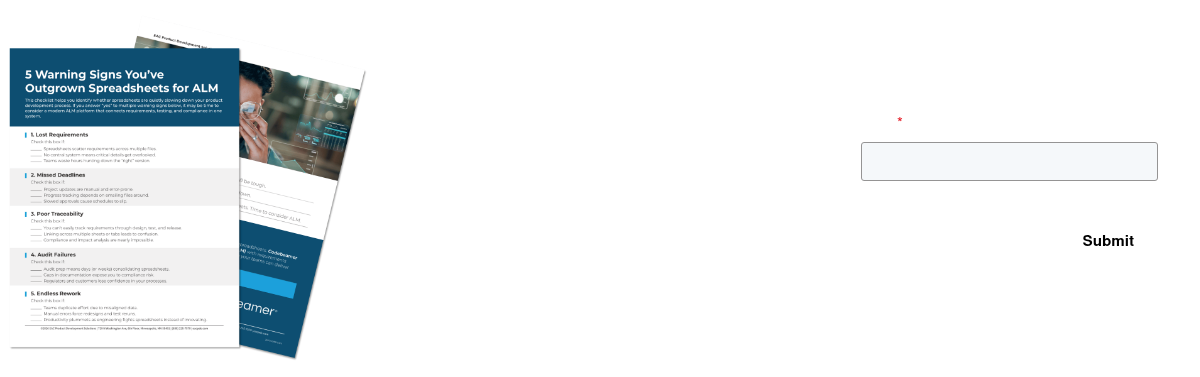
Download the ALM guide to understand why Application Lifecycle Management is essential for digital transformation.
Where Are You in Your ALM Journey
Companies come to ALM from varying challenges. Some are identifying early process breakdowns, while others are preparing for enterprise-wide transformation. Understanding your current maturity level helps clarify the right next step.
Early in the Journey
You may be noticing inefficiencies: requirements scattered across spreadsheets, limited visibility into testing progress, or audit preparation that feels reactive. At this stage, the goal is awareness: understanding how disconnected tools create risk and how modern ALM can provide structure and traceability.
Educational resources help clarify what’s possible before major changes are made.
Evaluating Solutions
If you’ve recognized the need for improvement, you’re likely defining what modern ALM should support: evaluating traceability capabilities, integration with PLM and CAD, Agile workflows, and compliance readiness. Want to know what a connected, scalable solution should look like in your environment?
Ready to Decide
When moving toward implementation, execution becomes critical. Success depends on process alignment, thoughtful configuration, data migration planning, and strong user adoption. A structured approach ensures your ALM investment supports long-term performance rather than introducing new complexity.
ALM Products & Services for Manufacturers
EAC delivers comprehensive ALM solutions that support engineering execution from requirements through release. Our ALM offering includes:
- ALM Products

Codebeamer
Ready to Take the Next Step with ALM?
Whether you’re exploring requirements management improvements or preparing for enterprise-scale ALM adoption, EAC helps you move forward with clarity.
Our team combines technical expertise with practical engineering experience to ensure your ALM environment supports collaboration, compliance, and innovation without adding unnecessary complexity.
Talk with an ALM expert at EAC to discuss your next step.
Common Questions About ALM
Manufacturers often ask similar questions when evaluating or managing ALM.
Below are a few of the most common:
Is ALM an Agile tool?
ALM is not an Agile tool but can fit into an Agile development environment. It manages the application lifecycle from conception to decommissioning, involving processes, tools, and people. Agile teams commonly use ALM tools to manage their projects. However, it’s important to note that ALM itself does not align with Agile principles.
What are the stages of application lifecycle?
1. Requirements gathering – identifying and documenting the functional and non-functional requirements of the application
2. Design – creating a detailed design of the application based on the requirements.
3. Development – writing the code for the application based on the design.
4. Testing – ensuring that the application meets the requirements and functions as expected.
5. Deployment – releasing the application to production or making it available to users.
- 6. Maintenance – addressing issues and making updates to the application as needed.
What is an application lifecycle?
The application lifecycle encompasses phases such as requirements gathering, design, development, testing, deployment, and maintenance. Each phase plays a crucial role in the application’s success, emphasizing the importance of thoroughly testing and meeting user needs.
What is the difference between ALM and PLM?
Application Lifecycle Management (ALM) and Product Lifecycle Management (PLM) are two distinct approaches to managing development. ALM focuses on software development’s lifecycle, including requirements gathering, testing, and deployment. In contrast, PLM focuses on a physical product’s full lifecycle, from ideation to its end-of-life. Overall, the main difference between the two is that ALM is for software applications, while PLM is for physical products.
Interested in exploring ALM and PLM integration with Codebeamer? Learn how it supports requirements management, traceability, and collaboration across software and product development teams in this blog.
Why is requirements management important for companies?
Companies rely on requirements management to ensure timely project completion, adherence to budget constraints, and meeting customer needs. Effective requirements management enhances communication and collaboration among stakeholders, resulting in improved alignment and increased customer satisfaction.
