
When companies invest in advanced digital tools like PTC Windchill, Creo, or Codebeamer, they expect measurable improvements: faster collaboration, streamlined workflows, and smarter decision-making. But over time, even the most advanced systems can drift away from their original purpose if processes evolve faster than the technology or if user adoption lags behind.
That’s where a Functional Group Assessment (FGA) comes in. It’s a structured business assessment designed to help organizations evaluate how effectively their teams, processes, and tools align with business goals. Whether you’re looking to improve PLM performance, optimize engineering workflows, or strengthen collaboration across functional groups, committing to an FGA provides the clarity and direction needed to unlock your next level of operational excellence.
Below, we’ll answer key questions decision-makers often have before committing to a Functional Group Assessment, and what you can expect along the way.
What are the business benefits of doing a Functional Group Assessment?
A Functional Group Assessment helps organizations achieve greater efficiency, alignment, and ROI from their technology investments. By evaluating how each department interacts with tools, data, and processes, the assessment identifies opportunities for productivity improvement and waste reduction.
One of the biggest benefits is tool utilization: uncovering where critical systems like PLM or CAD are underused, misconfigured, or disconnected from the broader product development ecosystem. Many companies discover that features they already own could solve daily bottlenecks, saving time and cost without additional software purchases.
Beyond efficiency, FGAs foster cross-departmental alignment. Engineering, manufacturing, and service teams gain a shared understanding of how their workflows connect, creating a stronger digital thread across the organization. In short, the FGA delivers a roadmap that turns insight into measurable improvement. This drives smarter decisions, better collaboration, and stronger performance at every level.
How do we choose between doing an internal review vs. contracting an external assessment like EAC’s FGA?
While internal reviews can provide valuable feedback, they often lack the objectivity and breadth of expertise that an external partner brings. An internal team may know the symptoms of inefficiency (slow approvals, version control issues, or low adoption) but they may not know the root causes or the industry best practices to fix them.
An external assessment like EAC’s Functional Group Assessment combines independent evaluation with deep experience across hundreds of manufacturing environments. EAC consultants benchmark your processes against industry standards, revealing gaps and opportunities that are often invisible from inside the organization.
Additionally, external assessments eliminate internal bias and department-driven assumptions. Because recommendations are data-backed and vendor-neutral, leadership teams can make confident decisions on where to focus resources for maximum impact. For companies seeking transformation, an external FGA provides both clarity and credibility in the path forward.
What metrics should we track to measure the success of the Functional Group Assessment and its follow-up actions?
To measure the success of an FGA, it’s important to define key performance indicators (KPIs) before and after the assessment. These metrics should align with your business goals and reflect both operational efficiency and technology adoption. Common metrics include:
- System utilization and uptime: Are teams using Windchill, Creo, or other digital tools more effectively and consistently?
- Cycle time reduction: How much faster can your organization move through design changes, releases, or approvals?
- User adoption rates: Are more employees actively engaging with the system following process improvements or training?
- Rework or error reduction: Have duplicate efforts or data discrepancies decreased after process alignment?
- Business goal alignment: Are teams meeting project deadlines, quality standards, and cost objectives more consistently?
Tracking these KPIs provides measurable proof of progress, and ensures the assessment leads to tangible business outcomes rather than just documentation. Many EAC clients integrate their findings into continuous improvement plans or quarterly performance reviews, maintaining visibility long after the assessment ends.
How do we prepare our team and functional groups for participation in an assessment?
Preparation is key to getting the most out of a Functional Group Assessment. Before the assessment begins, leadership should communicate the purpose and value clearly to all participants. The goal isn’t to find fault, but to uncover opportunities for improvement and make everyone’s work easier, faster, and more consistent.
A strong preparation plan includes:
- Identifying participants: Include representatives from engineering, manufacturing, quality, IT, and other groups connected to product data.
- Gathering documentation: Collect process maps, workflow charts, or tool usage reports that show how current systems function.
- Scheduling interviews and workshops: Plan sessions for each team so evaluators can observe how work gets done and where pain points exist.
- Setting expectations: Ensure teams know the process will be collaborative and that feedback is confidential and solution-focused.
When employees understand the assessment’s intent and outcomes, they’re more likely to provide honest insights, leading to more meaningful results and a higher return on investment.
How are results from the assessment used to improve alignment, tool utilization, and process efficiency?
Once the Functional Group Assessment is complete, your organization receives a detailed findings report and improvement roadmap. These results serve as both a baseline and a blueprint for ongoing progress.
The findings typically highlight specific areas where processes, data flows, or technology configurations can be improved. For example, the assessment may uncover:
- Manual steps in workflows that can be automated through PLM configuration
- Inefficient change control or document management procedures
- Lack of integration between CAD and manufacturing systems
- Low system adoption rates due to insufficient training or unclear roles
Using these insights, leadership can prioritize the most impactful initiatives. Those might include improving data traceability, refining approval processes, or standardizing tool usage across teams. Over time, this leads to stronger alignment between business goals and day-to-day operations, reduced redundancy, and more predictable project outcomes.
Do we need to purchase additional services after the assessment, or can it stand alone?
A Functional Group Assessment can absolutely stand alone as a complete, actionable engagement. Many organizations use the findings as a strategic guide for internal improvement efforts, identifying what to focus on and how to measure progress without committing to additional services.
However, companies often choose to extend their engagement with partners like EAC to accelerate results. EAC offers complementary services such as:
- Process optimization workshops to implement recommended changes
- Windchill administration or managed services for ongoing system health and uptime
- Training and mentoring to strengthen user adoption and capability development
- Follow-up assessments to track progress and recalibrate strategies
In essence, the FGA provides a roadmap, and partnering further ensures your teams reach their destination efficiently. Whether you manage improvements internally or with continued support, the clarity gained from the assessment remains invaluable.
Turning Insight Into Sustainable Improvement
Committing to a Functional Group Assessment is more than just a one-time exercise. It’s a strategic investment in clarity, efficiency, and alignment. The process delivers a 360-degree view of how your teams, tools, and processes function together, revealing actionable insights that translate directly into measurable business performance.
By partnering with experts like EAC Product Development Solutions, your organization gains access to deep PLM, CAD, and process expertise. This ensures every recommendation is not just theoretical but implementable in real-world manufacturing environments.
Whether you’re navigating a PLM upgrade, struggling with adoption challenges, or simply looking to maximize your technology ROI, an FGA helps you understand where you stand and where to go next.
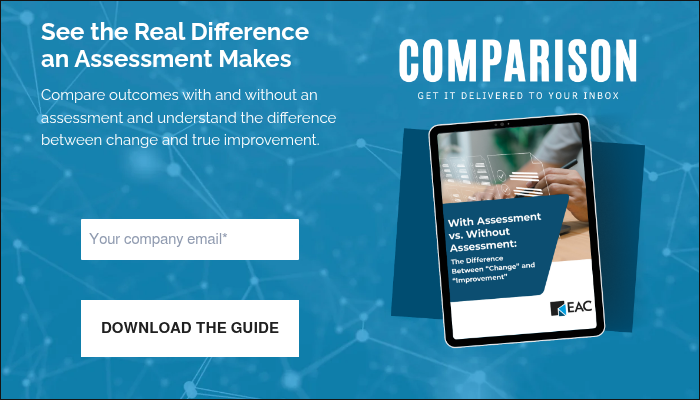
Ready to uncover opportunities for improvement? Explore the comparison of what it might look like to go forward with an assessment versus continuing on without one.