PTC Creo Simulate gives design engineers early insight into product behavior to significantly improve product quality, decrease rework, and save money with fewer iterations in the design process.
Virnig Manufacturing needed to maintain a high level of quality in their skid steer loader attachments and was looking to increase operational efficiency and customer satisfaction. Darin Virnig and his team use PTC Creo Simulate to reduce costs, decrease weight, and eliminate reliance on physical prototypes – ultimately reducing design time by twenty-five percent.
Check out how Virnig Manufacturing uses PTC Creo Simulate to change the way they innovate in early design stages.
Business Initiatives
When it comes to skid steer attachments, it doesn’t get better than Virnig. Located in the heart of Central Minnesota, Virnig Manufacturing has been designing and producing skid steer loader attachments for over 27 years.
However massive they may seem now, Virnig wasn’t always the manufacturer we know today. When Dean and Lois Virnig got their start in 1989, the business operated out of a two-stall garage repairing farm and construction equipment. After five short years, the company discovered its niche – creating skid loader attachments.
Today, all steps of the manufacturing process are completed in-house. From engineering and cutting raw materials, to machining, welding, and painting the finished product, every attachment is designed and produced at Virnig’s facility.
Virnig now carries over 40,000 attachment parts and offers more than 80 unique skid loader attachments. Headquartered in Rice, MN, Virnig’s 67 employees have over 400 years of combined industry experience. The family owned and operated business has grown into a premium skid steer attachment manufacturer supplying North America and beyond.
Business Challenges
Virnig has been challenged more than ever to produce high quality, lightweight attachments in order to outperform the competition.
Darin Virnig, Manager of Production and Engineering explained, “We try as a company to get repeat business and to demonstrate to our customers that we have a solution for their problems. As our products continued to get more complex, they became heavy and overbuilt compared to our competitors. We knew we needed to lighten the machinery parts to reduce cost. As a company, we had to look to practices that gave us confidence in our processes before jumping into prototyping.”
Darin knew his team needed to maintain a high level of quality and also saw an opportunity to increase operational efficiency and customer satisfaction. To deliver on this goal, Virnig needed to provide employees across the organization with an in-depth view of how designs performed in real-world conditions.
This understanding would help Virnig reduce or eliminate product related issues in the field, lighten machinery parts, and reduce costly prototyping. By virtually testing real-world conditions, Virnig could maintain high-quality standards while optimizing and adjusting to their product lines.
Solutions – PTC Creo Simulate
Eager to reduce costs, decrease weight, and eliminate reliance on physical prototypes, Darin and his team turned to a PTC product called Creo Simulate. Because the engineers had used PTC Creo (formerly known as Pro/ENGINEER) as their primary CAD tool for several years, they felt it was only logical to turn to PTC’s Creo Simulate.
Creo Simulate is designed to provide users with accurate design simulation capabilities right within their CAD platform. By using the software’s simulation tools to create virtual prototypes, users are able to visualize and test a product’s structural performance before cutting any steel. This saves Virnig’s engineers time, energy, and money as they are designing new products.
Prior to implementing simulation software, Virnig tested product designs using trial and error or the build-and-break method. As products became more complex, the team realized the importance of accurate structural analysis. Virnig’s engineers found PTC’s integrated simulation tool easy to design, analyze and optimize the attachment lines.
Improving engineering design standards with early simulation
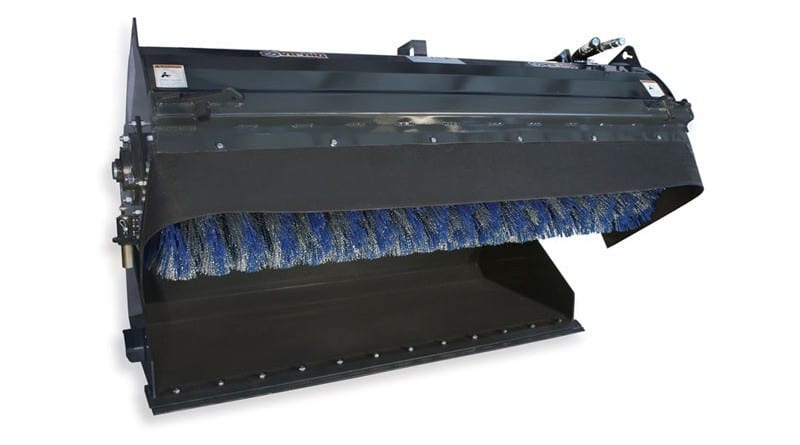
Virnig used Creo Simulate to innovate their most popular product, the Pick-up Broom. Traditionally the product consisted of a top with hydraulically driven bristles engineered to propel dirt into the bucket located on the bottom. With the Pick-up Broom, in particular, Virnig faced challenges as they attempted to lighten the machinery parts. To effectively analyze the deflection and strength of the product components, Virnig needed to test several design variations.
Using Creo Simulate, the team was able to virtually test multiple product designs in real-world conditions. At the touch of a finger, Virnig identified overbuilt areas on the Pick-up Broom. Their findings directly translated into lowered manufacturing costs, and lighter weight products that adhered to quality and manufacturing standards.

With the help of Creo Simulate, Virnig was able to reduce the Pick-up Broom cost by 5% without compromising quality. Creo Simulate also allowed Virnig to save 10% on labor and assembly time throughout the product development process by eliminating most of the expensive and time-consuming prototype manufacturing.
Darin explained, “We were able to resolve the problems we had with field issues as we got more comfortable with the software. We saw it replicate places that had problems showing us the high-stress areas and factors.”
The benefits didn’t just stop there. This PTC simulation software allowed Virnig to use analysis early and often to verify and optimize the attachment product’s design integrity, function, performance, and cost. On average the company saved 25% on design time.
Darin stated, “We were able to finish the product faster, especially the structural parts that we manufacture by cutting and molding. Simulate on average has provided us a time savings of at least 25% because we don’t have to do as much trial and error on testing and prototyping.” Today, Virnig saves an average of 5 hours on every product they manufacture.
Darin explains what he considers the real value of Creo Simulate, “We have saved material, labor, and product while being confident that our quality hasn’t been compromised. Creo Simulate is saving us money and putting us at a competitive advantage – there is no doubt about that.”
By integrating the latest product development technologies and using top-of-the-line materials, Virnig continues to be a leader in the skid steer attachment industry.
Learn more about PTC Creo Simulate or contact us.
Designing a product without integrating simulation into your workflow is like giving a concert but never rehearsing. Why would you do that?
Top Performing organizations meet cost targets, remain on spending plans, and beat their due dates. One way they accomplish these objectives is by utilizing simulation tools to empower their organizations. Here’s 10 ways simulation will put you ahead.
1. Simulation software = better design decisions
Simulation tools enable engineers to have better insights throughout the design process.
For example, with the use of simulation engineers can conduct sensitivity studies, analyze trade-offs, remove excess materials and even evaluate motion envelopes.
By using simulation during concept design, engineers are able to explore and consider more options.
These options permit engineers to see the influences and effects of different design guidelines and limitations.
Testing many conditions, simulation software allows engineers to narrow down choices for the best concept.
This is how engineers are able to make better, highly informed design decisions.
2. Simulation helps avoid over engineering
By simulating your designs in a variety of environments, you can easily determine what is necessary within your design and what is not.
This helps engineers eliminate excess materials, and ultimately create better products.
3. With Simulation software, you find problems earlier (while they’re still cheap to fix)
Engineering simulation software helps organizations discover hidden interactions that can cause big problems.
How? It’s simple.
If the materials you’re using to build and design a product can’t perform under stress, you can find out early in the design process.
This helps your design team get it right the first time.
4. Simulation tools improve product quality
Simulation tools enable engineers to analyze and validate the performance of 3D virtual prototypes before the part itself is created.
With the ability to validate and test designs early in the design process, engineers are able to create and evaluate more concepts and ideas within allotted time frames.
This means more ideas, more designs, better quality and ultimately a better product.
5. Simulation software improves product reliability
With simulation software, results are accurate and reliable and can be easily calculated with very little input from engineers.
By using simulation-driven design to optimize product performance, quality and durability- you can be sure that your is more than reliable.
6. Simulation tools cut product development time
Organizations are able to reduce product development time with simulation tools because less time is needed for physical testing, fixing late problems, and rework.
When design engineers know how to run simulations, they understand the requirements for the analysis model. By taking these requirements into consideration as they design, model, and build products, the analysis becomes easier and takes less time to prepare.
7. Innovation is increased with simulation
With the help of simulation tools, engineers can also be more innovative.
Time-savings allotted from simulation and virtual prototypes enable design engineers to evaluate more design iterations.
8. Simulation helps you get to market faster
Simulation tools help streamline product development activities by enabling concurrent design and analysis.
How? It’s simple.
With simulation, the analysis process is faster. For instance, you can forget any reliance on 3rd parties for analysis because you are able to now do it in-house.
By identifying and eliminating errors early in the design process you will resolve errors early, eliminating late-stage changes and tedious rework. This will also greatly speed up your processes.
Simulation tools empower design engineers to make better design decisions.
Better design decisions ultimately produce more competitive products that cost less and get to market faster.
9. In the long run, simulation tools save costs
Simulation helps engineers make better design decisions at much less cost because they can subject virtual models to real-world forces.
By using fewer prototypes and focusing simulation on areas of high sensitivity and fatigue, an organization can save time and money.
For example, engineers can reduce product costs by optimizing designs to meet multiple objectives, such as maintaining a product’s strength while reducing its weight.
This is exactly how the use of analysis and early optimization to properly size geometry can reduce material costs.
Aside from material costs, how do product failures, warranty, and repair cost impact company profits? Tremendously.
Using simulation tools organizations can avoid costly recalls and reduce after-market service, warranty, and repair costs.
It’s easy to see how simulation tools will save you money simply by eliminating the need for project re-work, prototyping, and over-engineering
10. More competitive products
Simulation software provides engineers with additional insight, which leads to better design decisions and product optimization.
By using simulation, design engineers are able to develop higher quality products that are easily differentiated in the market.
If you are an OEM supplier to a major fortune 500 manufacturing company it probably took you a while to become their supplier. You had to prove to them that you could deliver a quality product on time, at a fair price.
Now that you have won their business it is probably equally as important to maintain that business as it was to win it in the first place. Your company probably has a nice cash flow and your employees are enjoying a nice secure job because of this win. However, the most important thing that will keep your customer coming back to you is quality.
Most major manufacturing companies realized years ago that the sooner that you can discover flaws or issues in the design phase, the easier and more cost-effective it is to fix the problem.
They found out that after completing the design process in CAD, they could move on to using simulation software, like ANSYS, to simulate prototypes. By simulating their prototypes they are able to run multiple simulations of their prototypes at one time and pick out the prototype that met their requirements to move forward and begin manufacturing.
Over the years these huge corporations have saved millions of dollars in time-savings and reduced the amount of times projects have to be constructed.
In the interest of time-savings and cost-savings, I suggest you consider looking into a simulation tool yourself. As your customer will appreciate knowing that their supplier realizes how important a quality product is. Who would you rather buy from? A company that has thoroughly tested their product or one that hadn’t?
If you’re interested in learning more about the benefits of simulating your products early and often, learn more about simulation here.
In the last 6 or so months, I have had the honor and privilege of interviewing some of our customers. At EAC, we are dedicated to continuous improvement and one way we gain perspective of where we stand is by capturing voice of customer metrics and case studies. It not only validates how we operate, but it also gives us an opportunity to share our customer’s successes with other companies that might be facing similar challenges. These customers are real, industry leaders who are PTC software users and cheerleaders for EAC. I hope you can relate to our customer’s stories and enjoy reading how they worked through their business challenges and objectives with the help of EAC and PTC.
For today’s voice of customer bit, I’d like to highlight FSG Design (Pennsylvania). They produce innovative solutions for a variety of industries, including: robotics, military, automotive, and medical. Because of the strict tolerances within these industries, FSG’s projects require a CAD tool that is powerful, adaptive, and has the capability to create pristine surfaces.
CEO & Principle Frank Glogowski has found that using Creo Parametric 2.0 along side the Interactive Surface Design Extension (ISDX) has increased his overall productivity by a whopping 25%. Glogowski also said that ISDX meets 98% of the surfacing needs for his organization.
Glogowski has also used other tools like ICEM-Surf, which is for highly complex surface modeling geared toward the automotive industry. My favorite quote from the interview came from his experience. “There is a direct connection with the ICEM-Surf data and ISDX data and I am able to work bi-directional which is really nice. Once one surface is set in, I can take care of all engineering with Creo and the ISDX Module.”
In the grand scale of company size, FSG Design is considered a Small Business. It is worth pointing out that world-class tools are not out of reach for smaller companies. FSG was looking for a way to adopt and upgrade to great software while keeping the budget in check.
If you’ve got comments about how ISDX is working for you, or have questions, get the conversation started below.
