
- Deeper understanding of product performance
- Faster ramp-up, shorter development cycles and quicker time to market
- Reduced design-cycle times
- Fewer prototypes and first-time quality at reasonable cost
- Reduced warranty liability and exposure
This article talks about the barriers to simulation driven design faced everyday by engineers throughout the product development process – and how your organization can overcome them. We speak to product development companies and teams every day. Most strive to achieve:
Odds are you’re already familiar with the traditional product development process. Taking ideas from concept, to design, simulation, prototyping all the way to manufacturing your products. For many years, industry has tried to consistently use simulation as a part of that process; for good reason. It typically improves quality, on-time delivery, and customer satisfaction.
Unfortunately, when simulation is used as a part of the product development process, it’s almost always used as the final validation step after a design is practically complete. But the fact is… that’s not exactly the vision of “simulation driven design” that the industry has been striving to achieve for years.
So why is that? Let’s talk about the common barriers holding many companies back from achieving simulation driven design.
Common barriers of Simulation driven design
1. Engineers feel they need to consult a simulation expert
Often, engineers feel like they don’t have the expertise to run simulations while they design – they feel like they need to consult an expert that may not be directly accessible. This creates design challenges early in your product development process.
2. Engineers feel they need a simplified copy of the actual design model
Often, a simulation expert’s initial task is to figure out how to simplify a copy of the design model so that the simulation will run in a reasonable time and still provide an accurate actionable result. Many engineers don’t feel comfortable making the call regarding what part of their design is critical for a successful simulation.
3. The iterative design process can be complicated
We can all agree that the design process is an iterative one. We can also agree that designing products is complicated. If it wasn’t, everyone would do it.
Certainly, a design engineer would want to use simulation as he/she iterates a design, but this would require running a simulation that could take hours – on multiple uniquely simplified copies over and over again. It’s just not efficient. It’s too disruptive to the design process. Because of this, design engineers generally don’t do it.
The solution: Simulate Earlier in the Design Process
What product development teams really need is a simulation tool that is fast, responsive, and so simple to use that it can literally keep up with design engineers during every step of the way.
No copies. No waiting. Just immediate simulation results throughout the design process.
By using simulation capabilities that are ‘pervasive’ across a concept and detailed throughout design stages – your organization will break down the barriers between design and simulation. Requirements and Quality.
That is the key.
The best part? There’s a solution that gives every design engineer what they need to truly achieve simulation driven design.
It provides design engineers with the ability to instantly understand how product design changes can impact a products performance. This solution is called Creo Simulation Live.
The solution that makes simulation driven design easy
PTC achieved an overarching goal to remove simulation barriers for product development teams. They provide the best and broadest portfolio of engineering simulation software, putting the best in class design and simulation capabilities into a single product available to the fingertips of every design engineer. It’s called Creo Simulation Live.
How Creo Simulation Live Works
Creo Simulation Live uses a unique technology approach to deliver simulation results interactively as a product is being designed.
This solution compliments existing simulation offerings that tend to focus more on the analyses that require higher levels of fidelity or are used as a final validation step.
Creo Simulation Live works differently because it does not require the user or designer to be an expert in the field of analysis. They simply need to know basic constraint techniques and away they go.
Using this simulation technology analysis setup and simulation is fast and easy.
In fact, engineers are able to quickly learn the tool navigating a familiar command ribbon UI, context sensitive menus, RMB command access, simplified workflows and engineering terminology. Because, again, Creo Simulation Live puts real-time simulation right in your Creo design environment.
Creo Simulation Live even uses intuitive menus to define and place loads, and constraints. It allows simulations to be created and visualized in minutes and updated on-the-fly. It gives design engineers instantaneous feedback on design decisions.
How much can Simulation Driven Design Save You?
Solving design challenges with instantaneous simulation sounds great, but let’s talk about the return on investment (ROI) it could provide your organization.
Engineers across a diverse range of applications can take advantage of the many features that Creo Simulation Live offers to reduce both time and expense in the design process. These include:
- Optimizing the product design and identifying issues early in the design process
- Reducing the need for multiple heavy analysis iterations or prototypes
- Mitigating the risk of product failure, warranty and liability claims
Investing in Creo Simulation Live gives your engineers a tool that enables them to realize their full design potential.
Just like any business investment, engineers must be able to prove that the results obtained by using Creo Simulation Live are greater than the resources invested, and it’s worth the investment. On a basic level the return on investment (ROI) is the calculation of an investment’s cost versus its benefit.
To calculate an approximate ROI on Creo Simulation you don’t need to be an accountant, I will keep it simple! Try using the following formula: ROI = ((Gain of Investment) – (Cost of Investment)) / (Cost of Investment)
The Gain of Investment is the amount of money your organization will gain from using Creo Simulation Live.
Remember, money your organization does not have to spend, such as prototype costs, should also be included in your Gain of Investment number. E.g. the value of reducing the number of physical prototypes, the expense saved by reducing the number of hours spent on non-final design simulations, etc.
Your organization might also include the improved quality resulting in reduced cost of product warranty and repairs. In addition, you may also consider the value of the time saved in the product development process when using Creo Simulation Live.
Creo Simulation Live can significantly reduce the number of design and prototype cycles, allowing more robust products to be marketed earlier. The Cost of Investment is the amount of money your organization will spend on Creo Simulation Live. The most obvious cost is the price of the Creo Simulation Live software. To obtain specific costs for your organization reach out to us.
Your organization may also want to include the cost of training or implementation for the software. We can help you figure out the bottom-line investment in things like software and training. When calculating ROI make sure to document two things that will have an impact on your calculations, the timeframe, and the precision of your numbers.
Pick a timeframe for your calculation that is relevant to your organization (in the case that you are unsure as to what this might mean for your organization, we would be happy to assist). One year is a good timeframe to start, allowing the results to be annualized.
Your ROI calculation should be an estimate, and not down to the last dollar. Many of your numbers will be approximations. Document your assumptions as you compile the numbers. That way you can voice your justification if asked later on.
Let’s look at an example taken from the Aberdeen Group – Industry Averages for Simulation Driven Design (2008, 2016).
Current Customer Numbers:
- Annual Product Revenue: $100M
- Percentage of Product Revenue from New Products: 25% ($25M)
- Cost of Poor Quality (% of revenue): 8% ($8M)
- Annual Cost of Prototypes (% of new product revenue): 2% ($500,000)
- Number of Design Engineers: 100
Sample Creo Simulation Live Benefits:
- Cost of Poor Quality: 10% savings – ($800,000)
- Annual Cost of Prototypes: Decreased by 39% – ($195,000)
Creo Simulation Live Cost:
- 100 Engineers x (~$2,400/engineer) = $240,000
ROI Calculation:
- ROI = (($800,000+$195,000) – $240,000) / $240,000
- ROI= 3.1
This demonstrates approximately a 300% return on investment!
Given this kind of return on investment, you now have a solid argument as to why purchasing Creo Simulation Live is the best option to overcome your design challenges!
Now more than ever, product design and manufacturing teams are expected to create efficient, cost-effective products, without sacrificing innovation or quality.
That’s why so many organizations use the 3D CAD software known as PTC Creo Parametric to accelerate the design of parts and assemblies. Working with many product development organizations, we know that not every product is made equal.
The purpose this EAC Creo Clip is to show PTC Creo users, like you, functionality and capabilities you might not know about. Short clips, useful features, better designs – It’s that simple.
Fortunately, Creo delivers the most scalable range of 3D CAD product development packages and tools in today’s market.
In this Creo clip, we talk about how to check design interferences with Creo Parametric 5.0. We talk about how you may be able to skip the full interference check if you are looking to do a very quick analysis for interferences in specific areas of your models. Learn why, in some situations, the sectioning tool might be the best option.
Why are we talking about finding interferences with Creo’s sectioning tool? Most people are familiar with finding interferences in their models by using global interference checks, which is a great tool. Unfortunately, with larger models, it can take some time to run and it might not pinpoint the interferences that you are looking for.
Watch this short EAC Creo Clip that demonstrates how to find interferences in models using the Creo Parametric sectioning tool.
On November 20, 2018, PTC announced the ~$70M acquisition of an advanced generative design software company named Frustum Inc. Frustum’s technology leverages artificial intelligence (AI) to generate design options in a process called “generative design.” It will be worth your time to follow this acquisition and how PTC incorporates the technology into their flagship offerings. It should be a transformative addition to PTC’s Creo portfolio.
Frustum offers patented desktop and cloud-based engineering software from their headquarters in Boulder, CO. Their software enables engineers and designers to go beyond the limits of their personal experience by leveraging powerful AI capabilities that guide the discovery of high-performance, next-generation product designs.
When asked about the acquisition, Jim Heppelmann, President and CEO of PTC said “PTC is pushing the boundaries of innovation with this acquisition…Creo is core to PTC’s overall strategy, and the embedded capabilities from ANSYS and, later, Frustum will elevate Creo to a leading position in the world of design and simulation. With breakthrough new technologies such as AR/VR, high-performance computing, IoT, AI, and additive manufacturing entering the picture, the CAD industry is going through a renaissance period, and PTC is committed to leading the way.”
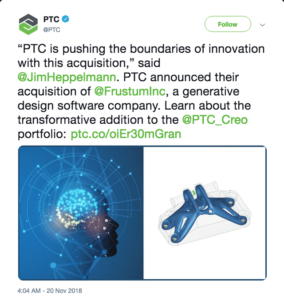
Earlier this year PTC announced a strategic relationship with ANSYS. Frustum complements this relationship and will help bring analysis upstream to the very start of the design process. With embedded Frustum and ANSYS capabilities, Creo will be able to recommend design approaches using generative design, guide the user through the iterative design process using ANSYS Discovery Live, and ultimately validate the full product design at scale using the broader ANSYS Discovery suite. With these capabilities embedded in Creo, engineers will have unmatched capabilities to rapidly drive product innovation.
Here is some more information about the acquisition from the official PTC press release…
“This acquisition is a natural step for PTC and its customers,” said Jeff Hojlo, program director, product innovation, IDC. “AI and machine learning (ML) are widely discussed as two of the most impactful technologies of the future. For design, engineering, and R&D, the potential positive impacts of complementing the development process with AI and ML are astounding: lowering cost of quality (which is currently 20-25 percent of annual revenue at the average manufacturer), improving product success rate (which remains very low with more than 80 percent of products failing), and improving time to market and time to revenue by meeting customer needs accurately the first time.”
The Power of Generative Design
With generative design, engineers can interactively specify the functional requirements and goals of their design, including preferred materials and manufacturing processes—and even indicate key design parameters that take into consideration purchasing decisions, manufacturing capacity, supply chain status, and regional-required product variances. The system then uses AI and powerful high-performance computing techniques to present design alternatives for consideration as a starting point or as a final solution. By removing the constraints of human imagination and experience, engineers will be able to interact with the technology to create superior designs and innovative products more quickly.
Generative design is appealing to PTC’s vast customer base as they seek ways to:
- Increase engineering productivity
- Improve innovation and conceptual design exploration
- Develop higher-performance designs that are lighter weight, with improved durability
- Optimize new products for improved manufacturability, reduce material costs, and decrease manufacturing cycle times
- Create complex geometries optimized for additive manufacturing
- Deliver better products faster
The Impact of Artificial Intelligence
Integral to Frustum’s technology is a powerful AI component that learns, evolves, and, ultimately, performs key tasks, including:
- Providing valuable feedback to a designer early in the design phase
- Optimizing designs for multiple objectives simultaneously and offering a designer with multiple novel design alternatives, which enables companies to substantially reduce engineering cycles
- Modifying designs to manage multiple requirements and constraints, physics, materials availability, manufacturing processes, and design objectives
- Automating testing the outcomes of the design with other enterprise insights, including costing, supply chain, and quality data
The Transaction
The transaction closed on Monday, Nov.19, 2018. The acquisition is not expected to add material revenue for 2019 or to be dilutive to the financial guidance PTC provided on Oct. 24, 2018.
Additional Resources
Forward-Looking Statements
This news release contains statements about future events, including business performance and the effect of the acquisition on our future financial results, the integration and development of solutions, and the expected value of the acquired technology to users. These statements are “forward-looking statements” and actual results may differ materially from those projected as a result of certain risks and uncertainties, including that the acquisition may not have the expected effect on future financial results and that the integration of the solutions may not occur when or as expected, and those risks and uncertainties described in PTC’s filings with U.S. Securities and Exchange Commission. These forward-looking statements reflect our beliefs as of the date of this release and we undertake no obligation to update or revise any forward-looking statement, whether as a result of new information, future events or otherwise.
Manufacturers always try to find a ways to streamline processes and ‘do more with less.’ It drives success in a world full of competition. One way organizations do this is by reducing process complexity with powerful product life cycle management (PLM) or change management software. Connecting your team directly to live operational data increases efficiency in all departments and allows your organization to save money and manufacture products faster.
EAC Product Development Solutions has partnered with PTC, the world’s product development technology leader, to bring organizations the products and services that they need to succeed in their industry. As a PTC Solutions Provider, we provide the maintenance, support, configuration, and training you need to implement change management software as easily as possible.
PTC Windchill Data Management
If you’re looking to do things like keeping better track of files, create and store Bill of Materials (BoMs), put CAD models and drawings in one place, eliminate the risk of two individuals working on a file at the same time, or secure your data without burdening IT – you’re looking for PTC Windchill.
PTC software – specifically Windchill – is a complete PLM solution that provides capabilities such as:
- Bill of Materials (BoM) Management (EBoM, SBoM, MBoM)
- Configuration and Change Management
- Requirements Capture Management
- Early insight into product quality, reliability, and risk
- Efficiently making product variations with a structured platform
- Product Data Management
- Collaboration across all departments with accurate, up-to-date information
- Seamless software integration and defining standards
PTC Windchill is a PLM solution that provides a smooth transition from design to manufacturing with universal access to all critical product data information so that the process isn’t fatigued with delays.
PTC Windchill, Change Management, eBoM Case Study
ALM Positioners, a leading manufacturer of positioner lifts located in Rock Island Illinois, needed PTC Windchill. The company offers unique, customizable weldments and assemblies that require a lot of CAD models and other product information from engineering before manufacturing even begins. Due to extensive product customization and configuration depending on the needs of their customers, ALM needed a better solution to manage product data. They were drowning in paper files – a lot of which had outdated information.
EAC’s implementation team helped ALM Positioners transition to a digital workflow using PTC’s Windchill software. Windchill helped ALM save up to 4 hours per project by integrating EBoMs and MBoMs into their ERP system.
Watch the ALM Case Study on PTC Windchill to see how it has consistently proven to be a leader in the industry and outperformed competitors when it came to product lifecycle management.
It’s no wonder people like you are researching ways to reduce downtime. A 2016 ITIC survey found 98% of organizations said a single hour of downtime cost over $100,000. 81% of respondents said an hour of downtime cost their organization over $300,000!
Remote monitoring, remote diagnostics, and predictive analytics are helping organizations reduce downtime. They’re transforming the way companies manage and service their manufacturing operations. As Gary Wollenhaupt calls out in his article about how IoT Slashes Downtime with Predictive Maintenance; manufacturing machinery and other assets can now be connected to the industrial internet of things. Predictive maintenance will begin to replace scheduled maintenance based on mileage, time, usage, or other predictive measures.
We now have the ability to digitally peer into the inner workings of an asset to understand performance, tolerance, temperature, or any number of other factors that can be measured using sensors and device networks. When harnessed, this data is the is the answer to the question being asked by many organizations – “How do I reduce downtime and increase productivity?”
There are many tools on the market to collect the data streaming from sensors and turn it into useful information. We recommend PTC’s suite of industrial connectivity / Industrie 4.0 solutions. We’re not alone. Forrester Researched named PTC and IoT Software Platform Leader and PTC’s ThingWorx was named a leader in “IDC MarketScape: Worldwide IoT Platforms (Software Vendors) 2017 Vendor Assessment.” PTC’s integrated solution suite includes ThingWorx, Vuforia, Kepware, and others.
Our team of solution architects and technical experts can help define and implement the solution(s) you need. We want to help you begin remotely monitoring your assets, whether manufacturing or remotely deployed (products), and leverage predictive analytics to reduce downtime and save money. It may involve a custom solution set, or it could simply be PTC’s eacy-to-deply Manufacturing Apps.
EAC is here to take on as much or as little of your project as necessary. We can simply provide the software for your own team to implement. Or we can manage the entire process from installation, to implementation, to integration and front-end development.
Please contact us. We want to help you leverage technology to reduce downtime and improve your bottom line.
Here is a better description of the solutions mentioned above:
The ThingWorx platform includes compatible modules that deliver the functionality, flexibility, and agility enterprises need to implement industrial IoT apps and AR Experiences. This includes industrial connectivity, analytics, and application enablement. ThingWorx is unrivaled in its ability to help companies quickly connect data streams and publish dashboards or mashups.
Kepware is a single solution for collecting, aggregating, and providing secure access to industrial operations data. The ThingWorx Native Interface integrates the Kepware KEPServerEX with ThingWorx easily and securely. This integration lets organizations take data streams from almost any manufacturing asset and present it in a useable format. The Kepware family also offers a predictive analytics engine in addition to other Machine-to-Machine (M2M) and Data Tunneling solutions.
Vuforia is PTC’s solution for creating rich augmented reality experiences for applications such as work instructions, user training / manuals, asset monitoring, and service instructions. It lets users leverage the richness of 3D and insights from IoT to deliver compelling augmented reality experiences the help improve efficiencies, build better products and enable safer, more productive workers.
It is not too bold to say the Internet of Things (IoT) is just about everywhere. Some even say that IoT will have a greater impact on business and productivity than the introduction of the Internet itself.
Whether you embrace it or attempt to look past it, the wave of IoT has already started disrupting many industries.
So what exactly is the Internet of Things? Well, if you haven’t read the HBR article by Michael Porter and Jim Heppelmann, I encourage you to do so.
I am referring to the concept that our physical and digital worlds, in which we have always compartmentalized into separate realities, have begun to converge into a single new reality.
This new reality with the IoT has started to change the way we do business.
Our strategies have begun to take our physical products, parts components and factories, and connect them to our digital systems.
This has allowed us to collect data, analytics, performance measures and much more.
Although there is so much that you can learn about IoT, Here are 10 things you need to know about the Internet of Things.
1. IoT Can Fuel Your Existing Business Initiatives
The Internet Things should not be thought about as something separate and distinct from your business strategy, but rather as an opportunity filled with unlimited capabilities.
This revelation could possibly be the exact catalyst needed to meet your existing business initiatives.
No matter what your business is specifically looking to achieve, IoT can be a real game-changer.
Some businesses have used smart connected operations to discover efficiencies while reducing risk.
Others have integrated smart connected products by modifying and creating new assets and services to increase revenue.
I have also seen companies incorporate smart connected solutions to quickly bring products and services to the market.
Despite your industry, an IoT strategy can be shaped to help fuel your existing initiatives.
2. Everyone Over Designs
Moving from IoT strategy to value is complex.
There are lots of distractions and rabbit holes to go down.
Achieving your IoT initiatives requires focus.
By this, I am referring to the importance of strategically mapping out the innovation that you are looking to drive.
Before deploying an IoT strategy, make sure to ask yourself if the concepts you are looking to implement match to the strategies you are pursuing.
3. There Is No Time Like The Present
Don’t over think it, just get started.
Your company has a chance to take part in one of the greatest economic value adding opportunities of a lifetime.
This is your chance to embrace change and see all it has to offer.
Companies that are able to identify the opportunities and quickly bring to market solutions with IoT will be the leaders of decades to come.
4. Think Wrap/Extend, Not Rip/Replace When it Comes to the Internet of Things
The idea behind integrating the IoT into your business strategy should evolve around bettering your processes, not replacing what you have done so far.
This is your time to pro-actively use the IoT to drive growth and optimize your current business operations.
5. The IoT Stack is a Huge Help
The IoT stack is a handy way to break down any IoT project into manageable chunks. Think about it this way.
Before adopting innovative technologies your company must establish frameworks, protocols, and standards that are consistent with your business strategy.
Your framework should revolve around the problems your business is looking to solve.
By breaking down your IoT solution into 5 layers you can better understand the business technology tradeoffs that are needed at each level and the system as a whole.
6. Zealots and Laggards Are Everywhere. Beware.
It’s easy to get distracted by the daily grind and to put off getting started.
Change is a scary thing for all of us, so it’s easy to procrastinate.
Doing nothing is one of the biggest threats when it comes to the Internet of Things.
The reality is, big change is what can define success.
Don’t let your company develop a reputation as a technical laggard in the IoT arena.
7. Avoid The Simple Small Tool Sets
If you’ve ever heard the saying “go big or go home”, it defiantly applies to an IoT strategy.
So often I see companies who are hesitant to make a big change, resorting to small easy to adapt ideas.
If your company wants to see real results, you must avoid wasting your time on the small and simple projects.
Running test pilots to assess potential value is not how you will reach your real strategic initiatives.
To see change, you must make a change. This is when you need to roll up your sleeves and make a connection to your real business issues.
8. The Control Engineers Are The Key to Success
On IoT projects, get to the Controls engineer — this is who has the keys to unlock the room or path to data that might already exist.
Who is your control engineer? This is the person that brings together disparate systems within your network.
A good control engineer knows how to design, develop, and implement the systems that will control your specified applications, networks and machines.
9. IoT is a Big Concept and Many Have Different Views
After introducing the concept of the Internet of Things to many different companies; it has become apparent there are many diverse views of IOT along with its purpose and benefit.
It’s important to remember that two people who seem to differ on the topic of IoT may simply be looking at opposite sides of the same spectrum.
IoT solutions offer limitless capabilities that can easily be tailored to your specific business needs.
This means what IoT can offer for your business, may be completely different than the purpose and benefit it can offer for another.
10. There Is Always a Way To Do Something with IOT
The Internet of Things can be applied to just about every business strategy that exists; it’s just a matter of working at it.
For example, IoT has been used for the complex systems of products like John Deer’s Farmsight to optimize the farm, to simple examples like the Babilat tennis racket that provides data about a player’s performance.
Device connectivity and data analytics enable a closed-loop, real-time digital thread that can connect your people, systems, and equipment across the entire supply chain.
With the rapid creation and developments of new IoT applications, any organization can connect, manage, and optimize complex sets of disparate systems.
See how IoT goes beyond connecting products and has expanded to enable manufacturing and service processes by reading these case studies from PTC.
When it comes to IoT, there is always a way to do something.
