
Smart devices and connected products, like the Apple Watch, raise an interesting question, what are the implications of transforming traditional products into smart connected products?
Now that we have sensors, connectivity, big data, and analytics, customers and businesses are leveraging this value to create new opportunities – here’s how.
Remote Operations
Connected products can share their data with their users, and likewise with the manufacturer, unlocking new service opportunities.
For example, I have the Nest thermostat in my house. I can adjust the temperature on my way home from work just but using a simple app control.
For a Minnesotan like me, this is pretty awesome when you experience winters like we have.
Remote Services
From a company perspective, remote access services are very valuable as well.
For example, just like a smart thermostat, manufacturers can automatically send updates to assets. Or if maintenance is required, technicians can often save time and money by remotely connecting to devices to ensure software and hardware are performing effectively. This can avoid unnecessary service calls.
Innovative Product Designs
Another great use case is how companies can change their product design strategies.
For example, IoT enables a new design strategy known as evergreen design. The premise is that when products are operating in the field, new software features can be built and delivered to a device to extend functionality and the usable life of a product. The Tesla car illustrates this concept well. Tesla actually used an evergreen design strategy to avoid a major recall.
A few years back, there were several instances in which the battery cell of the car actually rubbed against street curbs as the car turned corners, causing fires. Instead of sending all the Tesla cars back to the dealer, or a mechanic shop, the company sent a software update that automatically raised the clearance of the car chassis where the battery was located.
Tesla’s evergreen design saved the company money, as well as customer time, and money associated with a traditional recall.
Big Data Analytics
Another big game-changer in business is the value to be had from big data. Now that products can share information throughout their product development cycle and useful life, there is, in essence, a stream of data that we can collect, analyze, and use to inform all sorts of business decisions.
Wouldn’t it be nice to know when the average daily usage of your products or product segments is in decline or incline? It could drive new product innovation timelines, customer success strategies, and new revenue from cross-sell and up-sell.
Data Collection & Analysis of Consumer behavior
The practice of using big data is not new. For example, in the retail market, companies are using purchasing behavior data to inform their business decisions.
A great example comes from 2004 when Walmart conducted a big data study on customer purchasing behaviors prior to hurricanes.
What they found was surprising. A few days prior to the forecasted hurricane, people bought a significant amount of pop-tarts. In particular, strawberry pop-tarts. On the day of the hurricane, they bought more beer. Based on this data, Walmart adjusted their stock supply in anticipation of the new demand. This use case is unique in that data was originating from people’s shopping behaviors. What is different now is that we can collect and analyze data from products as well.
Remote Monitoring
Take the case of smart sports equipment. A friend I play golf with had a sensor attachment that told her about her swing, ball placement, and field location. So, as we were playing throughout the day, she was pulling out her golf app, observing her golf swing, and adjusting performance based on that data. This is great for the user, and there are also added benefits for the manufacturing company!
For example, the tennis racket company Babolat has sensors attached to their play pure drive product, which collects data about a player’s swing, the speed of their ball, and impact location.
Product to service transformation
Babolat also provides a training service, where based on the player’s performance, Babolat will provide consulting, hitting tips, and other development programs. In this use case, big data is transforming a traditionally hardware-oriented company into a service company as well.
This brings me to my last example, which illustrates a radical change in how businesses perceive product value.
Product-as-a-Service (PaaS)
Namely, products are now carriers for potentially limitless services based on how you creatively leverage their smart and connected elements. This concept is not new.
Products-as-a-Service have been pioneered in the aerospace industry.
For example, Rolls Royce licenses out their engines to airline customers, and they charge airlines for the millage of the planes as well as services associated with repair, and maintenance.
This is generally known as power by the hour. This product as a service concept is gaining a lot of attention in the IoT market.
For example, there is a big software battle for ownership of the car segment. Google, Apple, Microsoft, and the original car makers are attempting to get a slice of the services associated with cars, such as navigation, entertainment, and safety systems. This new service focus is really interesting for product development and associated business operations.
Bottomline – products are carriers of tremendous value. Now that we have sensors, connectivity, big data, and analytics, customers and businesses can leverage this value, and create new opportunities.
IoT Intro Class
At EAC, we want to make sure you don’t miss out on any revolution with respect to potential capabilities that you can add to your products- while we also realize the importance of basing your IoT initiatives around your mission statement. That’s why we created what we call our IoT Development Workshop.
We have made it our mission to help guide organizations like yours to explore and embrace the uncertainty of the emerging IoT market.
The internet of things (IoT) is a business and technology revolution. It not only enables the connection and communication with ‘things’ but allows us to manage them.
It allows our organizations to do preventative and predictive maintenance on ‘things’, do guided service on ‘things’, and create digital twins of ‘things’. It enables us to improve operational efficiency, significantly reduce downtime, and to develop new revenue streams.
What makes up the ‘Internet’ in IoT?
The internet is composed of two separate communities; the internet of people and the internet of things or IoT.
The Internet of People
First, let’s break down what we mean by ‘the internet of people.’
The internet of people has grown organically over the past 20 years and has evolved into becoming an interconnected network of billions of people. That’s right, billions. Its primary purpose is to connect people, collate information, and enable people-to-people interaction.
The internet of people allows people to connect by becoming a clearinghouse of information. People post information available to other people, generating a great deal of information that is being pumped into the cloud.
The Internet of Things – IoT
The internet of things has been growing organically for the past 10 years and has the potential to become much larger than the internet of people. Its primary purpose is to connect machines, people, and data.
The IoT also enables people-to-machine and machine-to-machine interactions. In the Internet of Things, things are pumping data into the cloud so products can be monitored, controlled, optimized, and automated. During this process, information and data are streaming into the cloud from both people and things.
Combining the internet of people and things
This leads us to the internet. As mentioned earlier, the internet is the combination of internets of people and things into one integrated network. (Of course, they never were really separate, but it helps to think of them that way to facilitate the study of IoT).
Why are businesses investing in IoT?
The market for IoT is huge! Today there are over 20 billion connected devices, and that number is growing at an incredible pace. With connected devices comes a tremendous upside opportunity for IoT investments.
Through 2020, estimates are as high as 1.6 Trillion dollars! In fact, McKinsy has determined that the economic impact of IoT will top 11 Trillion dollars by 2025! The reason companies are starting to make such big investments in IoT is because so much value can be created.
How the Internet of Things is impacting product value
The internet of things isn’t about the internet – it’s all about the things. The things are what’s changing. The trend of smart connected things is really accelerating now that there’s a computer of sorts inside just about everything!
Today, according to the US government Census Bureau, there are about seven billion people on the planet Earth. About one-third of these people are connected to the internet with smartphones, tablets, and computers- yet in 2010 we hit an important milestone where there were more things connected to the internet than there were people on Earth This suggests these connected ‘things’ aren’t just smartphones, tablets, and computers anymore – they are fitness bands, thermostats, vehicles and more! This is where real innovation is happening.
Today, almost everything we have around us is capable of connecting. I’m talking about buildings, appliances, machinery, farms, hospitals, cities – all kinds of things. Now there’s a massive investment that is feeding this rapid expansion of the smart connected products – the internet of things solutions market. The IoT solutions market includes the smart connected things, the connectivity services, the software platforms and applications, the security, the analytics, and really everything related to smart connected products.

IoT Development Workshop
At EAC, we want to make sure you don’t miss out on any revolution with respect to potential capabilities that you can add to your products- while we also realize the importance of basing your IoT initiatives around your mission statement. That’s why we created what we call our IoT Development Workshop.
We have made it our mission to help guide organizations like yours to explore and embrace the uncertainty of the emerging IoT market.
Augmented Reality (AR) and Assisted Reality for digital work instructions have become a growth driver, or at least consideration, for many industries.
Yet moving everything from paper or ‘digital hard-copy’ to digital AR experiences seems to be a daunting task for large and small organizations alike.
The truth is, there are many ways to incorporate augmented reality into service, but many of these can disrupt current processes and be a challenge to implement.
This is why, our company (EAC Product Development Solutions), developed and created an easier way to make service information more accurate, relevant and accessible.
It allows you to easily deliver the content behind AR instructions, manuals, and guides to digital devices such as tablets, head-mounted displays, or cell phones.
Implementing AR for service should be easy. That is why we created a better way.
The tool is called AR Instruct – It easily connects traditional technical publication content to the AR world.
Digital Work Instructions & AR Instruct
AR Instruct enables “hands-free” execution of work instructions using the latest immersive technology including: Augmented Reality, Assisted Reality, and Mixed Reality.
Our AR solution works as an AR publishing engine that repurposes existing S1000D, Arbortext, or XML, technical publication content and simplifies the transition to hands-free and mobile paperless instructions.
The best part? AR Instruct requires no content re-authoring and no content rebuilding. It’s really that easy.
AR Instruct can even dynamically publish up-to-date work instructions from the latest document revision on your server. This will ensure accuracy, compliance, and quality.
Watch the video below to get a quick and easy introduction to AR Instruct.
How does AR Instruct work?
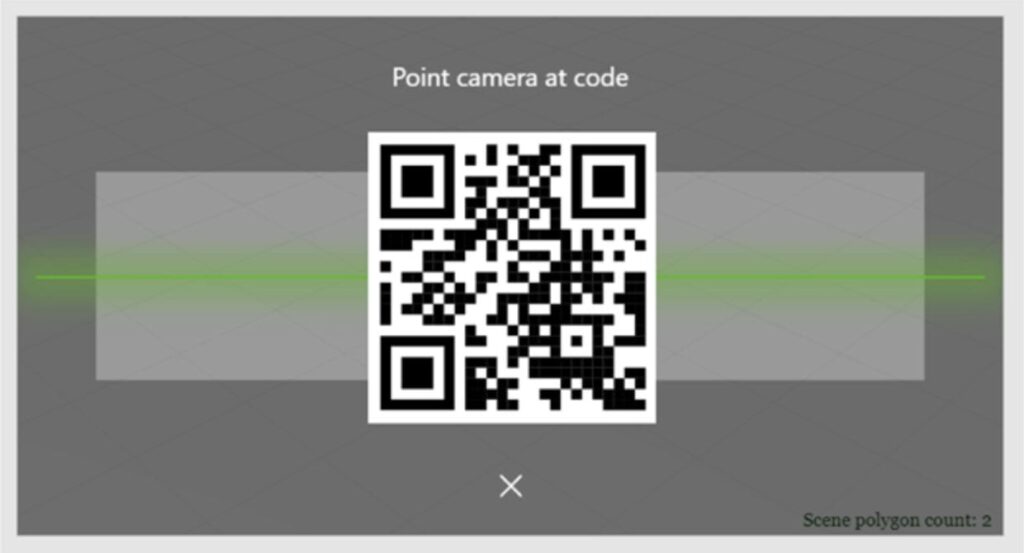
A Service Engineer scans a work order QR code to locate relevant service procedures.
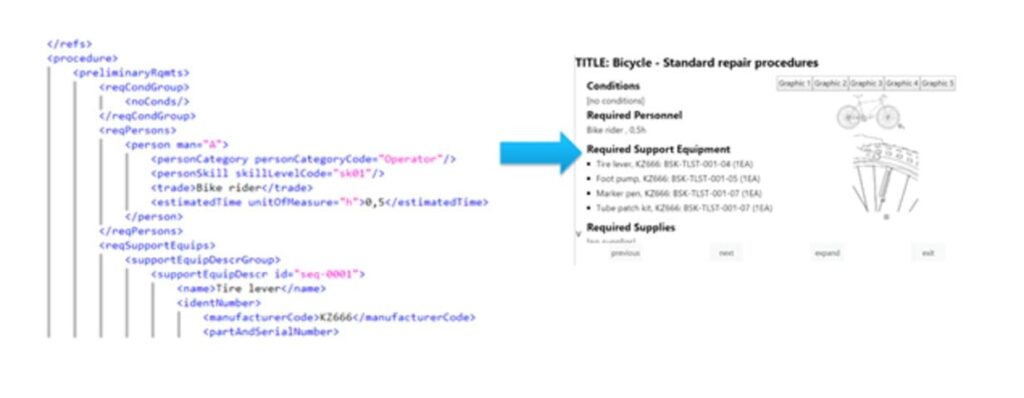
Our AR publishing engine, AR Instruct, retrieves XML content and dynamically formats it for AR viewing. This requires no manual publishing at all.
Using a digital device like a Vuzix or RealWear, the service engineer can navigate the AR content hands-free with voice commands.
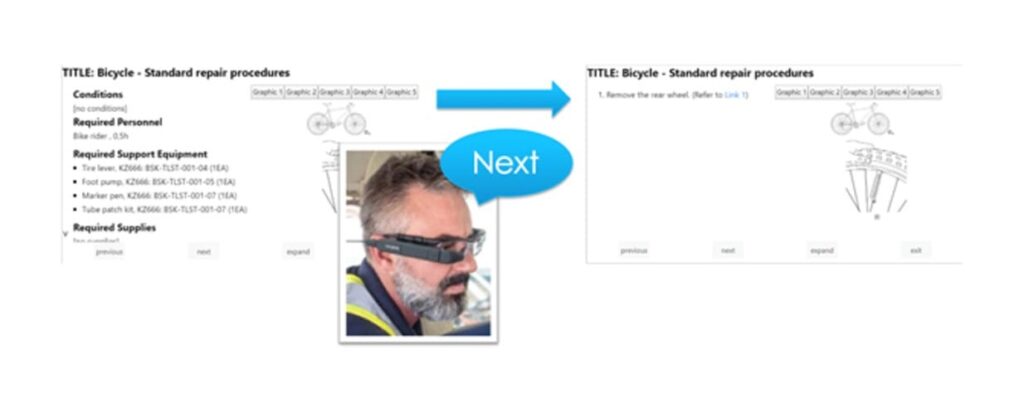
The Service Engineer can inspect each associated technical graphic related to the product.
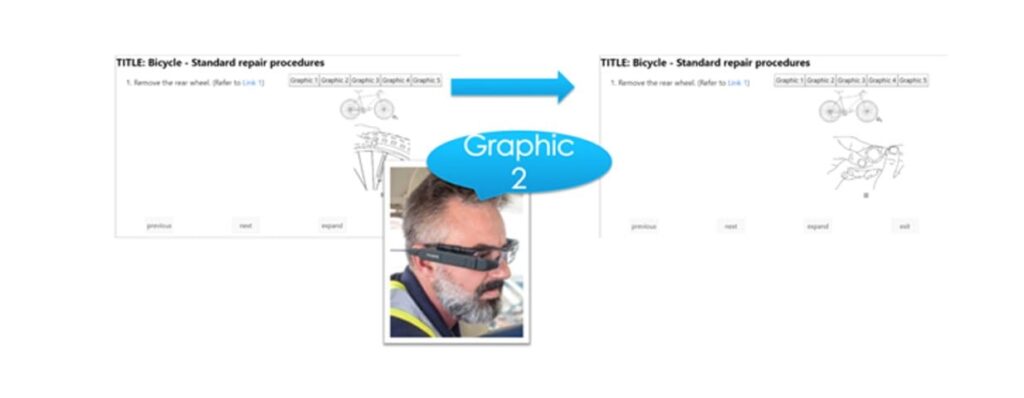
The Service Engineer can also expand any technical graphic or content for enhanced viewing.
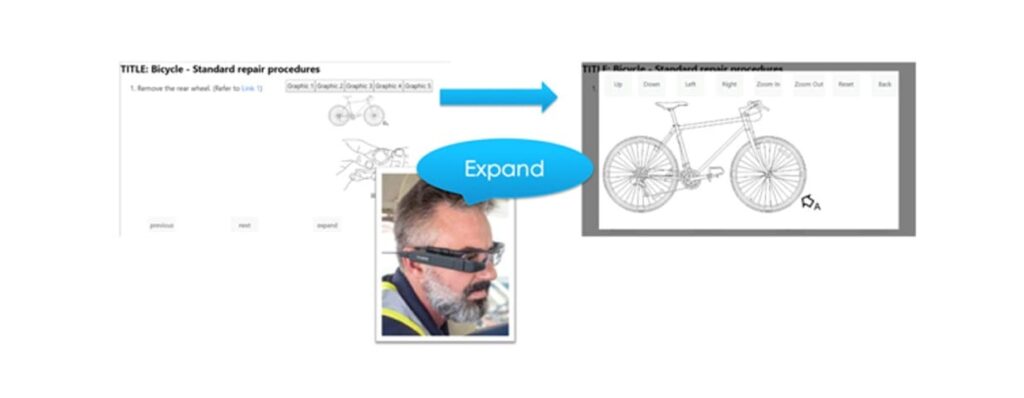
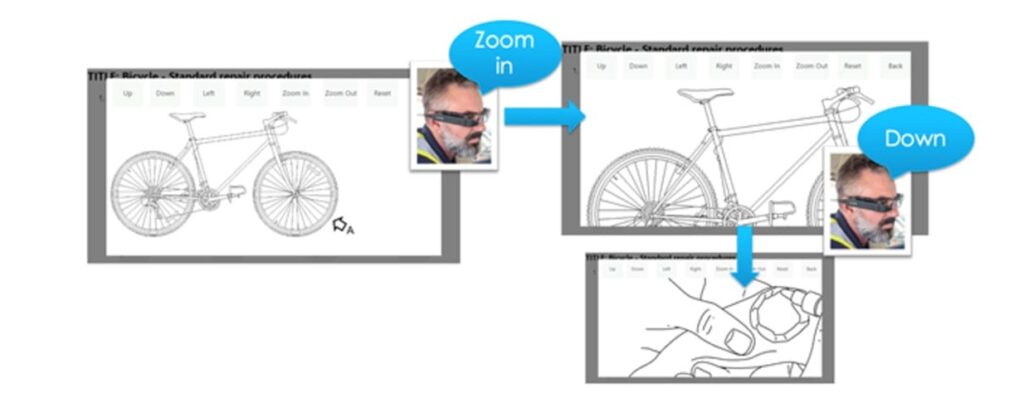
With the AR Instruct graphic viewer, the Service Engineer can pan and zoom any image by using voice commands. All buttons he or she sees are “readable” as voice commands.
Using voice commands, the Service Engineer can navigate links to cross-referenced steps or procedures.
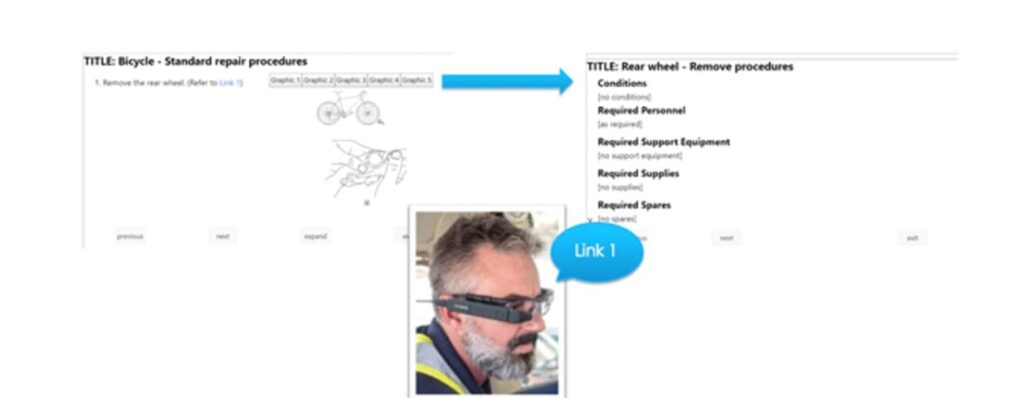
Once the Service Engineer is done with the cross-referenced content, he or she would be able to return to where they left off in the original service procedure.
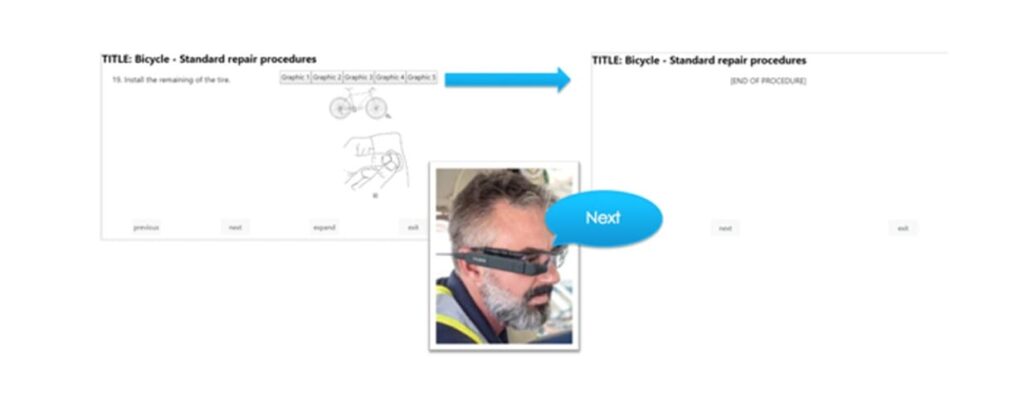
When all steps are complete, the AR Instruct software notifies the Service Engineer that the procedure is done and all steps are recorded as complete.
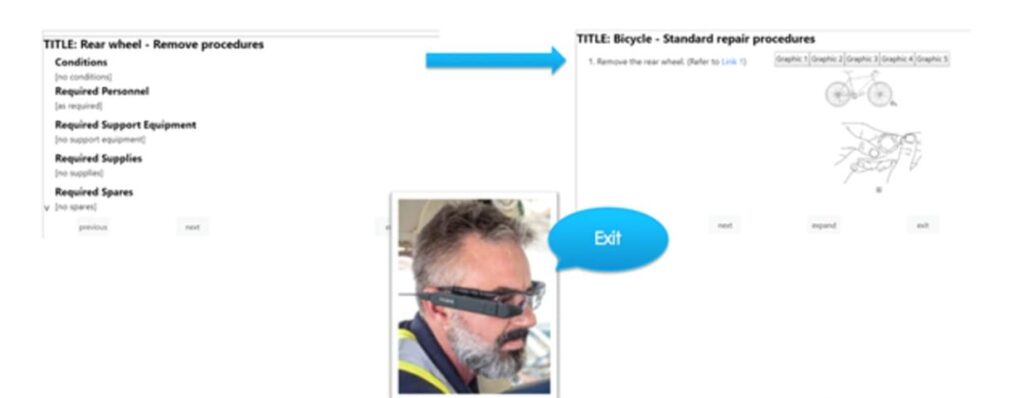
The Service Engineer exits back to the bar code scanner to begin a new work order or procedure.

It’s really that easy.
If you are looking to improve operational efficiency, appeal to the modern workforce, execute service checklists 3-5% faster and enable greater compliance and quality assurance over completed work instructions, AR Instruct is exactly what you need.
Want to see AR Instruct for yourself? Request a Demo today.
The future of digital transformation is happening now, and it is driving the future of all industries. This article highlights just about everything you need to know about the impacts and trends involving digital transformation.
No matter where your company resides on its digital journey – or even if you have yet to start with digital transformation, this article is just for you.
What is Digital Transformation?
Digital transformation refers to the concept of applying innovative uses of digital technology to solve traditional business problems.
For example, in a narrower sense digital transformation might refer to a simple concept such as ‘going paperless’. Yet, on a larger scale, it might refer to ‘achieving digital business maturity’.
Digital solutions not only enable organizations to achieve new levels of efficiency through automation, but they also open doors for creativity and innovation (rather than simply enhancing and supporting traditional methods).
Although applying the use of digital technology to solve traditional problems can offer numerous business advantages, many organizations have yet to begin the journey with digital transformation.
Digital Innovation: Where to Start?
With numerous applications, methods, and strategies, it can be difficult to know where to even start with digital transformation!
If this is the case with your organization, – don’t worry, you’re not alone.
According to a research study performed by Accenture and the World Economic Forum, 80% of executives stated they were completely convinced ‘digital’ advancements would fundamentally change and transform their industry within the next 5 years!
That’s right. Eighty percent! … And they’re not wrong at all!
In fact, digital technology has not only already begun to transform industries, but it has also started to transform the way the world experiences products. Despite the ability to recognize the effects that digital processes will bring, only 17% of the studied executives stated they had a strategy in place to address the challenge of digital transformation.
This left a shocking 87% to admit they had no current digital strategy in place whatsoever! This is exactly why, if you have not yet started your digital transformation journey, it’s important to realize A) It’s not too late and B) You are not alone. There is no better time to start than now!
Organizations are realizing the significant impacts that the digital transformation era brings and how it’s going to drastically change just about everything when it comes to the way we do business.
The Impact of Digital Transformation
The process of digital transformation is creating entirely new ways of doing business. It has begun to create new experiences for customers while adding entirely redefined value propositions for mature product segments.
This era of digital transformation has started to impact and define what products are and what they mean to businesses and consumers.
Product perceptions are changing
Digital trends have also started to influence purchase decisions and sales processes. As the digital world has advanced, the average consumer is making purchase decisions with a Product as a Service (PaaS) mindset.
This means the rise of digital transformation has driven consumers to be sold by the outcome of the product – the recurring value. Manufacturers can address this shift in the market demand archetype by embracing three technology categories – Internet of Things (IoT), analytics, and mobile.
The future and advancement of technology is happening now
Established power plays and industry lines are beginning to blur. You cannot wait until some time in the near future to start your digital journey.
If your organization is going to succeed going forward, you won’t want to be left behind in this new industrial revolution, or you will fail.
Whether or not you’ve noticed if your industry has been affected yet, the key message is the effect of these disruptive technologies doesn’t discriminate one sector or industry. Every industry will see a major impact due to these digital technology advancements… And it is happening right now.
‘Business as usual’ is no longer an option. Organizations must adapt in order to survive.
The future of Digital Transformation: Smart, Connected Products
Digital transformation is reinventing products. Products from cars, to jet engines, to pumps, to heavy equipment, to medication, and more!
Machines, assets, and devices are starting to communicate, learn, and react to newly accessible context as they exchange and leverage data from sensors.
We are talking about the area of ‘living products’ – meaning transformative products that are responsive, collaborative, reactive, and responsible. Whether products are B2B or B2C, there will be a totally different process in the way we think about how our customers are using our products in the near future.
The future is now. Don’t let the opportunity slip away.
The first step in your digital transformation journey should be a strategic one. Understand where you are, where you want to be according to your current framework or understanding, and where you’d like to be as you embrace future technology and evolve with changing markets and new opportunities.
EAC Product Development Solutions would like to help you begin your transformation. We provide the people, technology, and services to make any transformation successful. The first step should be a Product Development System Assessment (PDSA). This will help you understand the opportunity that lies in front of you. Request more information on the PDSA today and start taking your digital transformation seriously.
Already know that you want to start dabbling in the Internet of Things (IoT) but have no idea where to begin? According to ARM, The Internet of Things Business Index, “A lack of IoT skills and knowledge among employees and management is viewed as the biggest obstacle to using the IoT more extensively.” EAC Product Development Solutions is offering the perfect way for you and your team to get started – with a hands-on IoT workshop.
This workshop, called the IoT Strategy Development Workshop, is pretty much what it sounds like…and it’s not just another class that delivers ideas of how the future is supposed to look. You actually get your hands dirty and work with your team to develop alignment between business initiatives, strategic frameworks, and vision statements. The workshop is 2 days and involves 4 different sessions including IoT Experience and Excitement, IoT Basics, Strategy Development, and a “Shark Tank” IoT pitch to peers.
Below you will find a transcript of a Q & A with Brian Ignaczak, Director of Research and Development at NORMA Group. Read about his team’s experience with EAC’s IoT Strategy Development Workshop. Contact us if you think this hands-on workshop would benefit you and your team.
NORMA Group develops AN IoT Strategy
Q: How did EAC’s IoT Strategy Development Workshop help you better understand IoT and how a smart connected product strategy could impact your business?
A: “The EAC IoT strategy development session showed us how we could add value through the use of data… it focused on the value-added business opportunity and helped us get over looking at just the gadget side of IoT.”
“I think the biggest takeaway we had from the EAC development session is that we were able to develop an IoT mission statement that aligned with our business initiatives. It brought together a number of stakeholders to put together an IoT plan that fit our organization. That has probably been the most durable product from our strategy session.”
Q: When did you realize the IoT could create more value for you and your customers?
A: “The EAC strategy development session helped us realize that IoT could be a big area of development for us. We want to be a technology leader. It fits with what we do. We want to stay on the cutting edge of technology and make sure that we don’t miss out on any revolution with respect to potential capabilities that we can add to our products. The session with EAC showed us many ways this could be possible.”
Q: In what ways did EAC’s strategy team help guide you to find your value drivers?
A: “EAC’s strategy team helped guide us to find our IoT value drivers through templates they had us work through. As we worked through the templates, we were able to see an underlining IoT strategy that suited our organization. These strategy templates forced us to fill in what we were really trying to accomplish with IoT.”
Q: How did your team define and prioritize potential smart connected product ideas?
A: “EAC helped us determine where exactly we were headed with IoT. We were able to thoroughly evaluate if we were trying to open up new markets or try and better serve our existing markets.”
“Looking at smart connected product ideas that our organization could pursue, we decided to focus on opportunities within our existing markets.”
“EAC helped us identify two main areas that smart connected products could fit our business model. The first had to do with addressing customer pain points through the creation of digital products. The second had to do with upcoming changes to the market that were coming via regulations. Their team really showed us smart connected products that could work as solutions for our organization.”
Q: What has been the biggest benefit of having a customized IoT plan to fit your company’s strategy?
A: “From EAC’s strategy development session we were able to determine an IoT framework that we now can discuss. It made our endpoint more concrete. We realized things we weren’t going to do versus things that were possible for us to do. They helped us identify how the revenue streams would flow based off of that.”
“EAC helped our company by setting a realistic IoT vision we are able to work towards.”
Q: What impact did EAC’s IoT processes have on your own strategy building sessions going forward?
A: “EAC helped us realize the importance of basing our IoT initiatives on our mission statement. The impacts of these processes remind us to continuously review that we are headed in the right direction.”
“The strategy sessions EAC held gave our company an anchoring point with IoT. Now, as new opportunities come up, we use the methodologies we were shown to develop products that will meet our vision.”
Q: Describe how EAC’s hands on connected product experiences provided a relatable IoT experience for you.
A: “EAC’s hands-on connected product experiences opened our eyes to the vast amount of data that can be produced. It made us realize how quickly data can be processed in real time. It showed us the vast quantity, the amount of processing power that is available, and how it could all be used to produce something of value.”
“Seeing live data stream on the computer screen and realizing how quickly that is communicated was pretty eye-opening.”
Q: How did the IoT Concepts presentation help frame a basic understanding of your current state and future opportunity that IoT provides?
A: “The IoT concepts presentation helped frame a basic understanding of our current state and future opportunity. It goes beyond technology and starts explaining how others have started to transform their business. The case studies really helped us to understand how some of our peers in the industry have begun to adapt to the changing technology and transform their business.”
Q: During the strategy development session, how did EAC help you realize the alignment between your business strategy framework and business statement?
A: “During the strategy development session, EAC had us break up into groups. We all developed plans and pitches based on an IoT implementation. From there, each group presented their idea to the wider audience. It was really interesting to see how different teams approached the opportunity. After the presentations, we had an open discussion as to what the pros and cons were of the different scenarios that were presented. We are currently moving forward with the winning concepts of those strategic plans.”
Q: Do you feel that EAC had the proper techniques, strategies, and knowledge behind IoT to help implement these new strategic initiatives?
A: “EAC absolutely had the proper techniques, strategies, and knowledge behind IoT to help implement our new strategic initiatives. They have been a very valuable partner for us throughout the process. They are the reason why we have been able to start moving forward with our development. We have made a lot of progress since then.”
Q: What might you say to other companies considering a strategy development session with the EAC specialists to develop or implement an IoT plan?
A: “I feel that EAC’s processes are a great way to jump-start IoT strategy development. Having an outside voice is a very important aspect of that. They come in with a different point of view and it really helped bring together the different viewpoints from our stakeholders and teams.”
“EAC’s processes definitely helped us push forward. (EAC) has been a really good partner in furthering what we’re trying to accomplish. For us, getting beyond just the technology side and really trying to build IoT into a business plan is one of the things that they have emphasized. They helped explore the best possibilities for us.”
“We have been more than happy with the engagement of EAC. We feel that they have a tactical view of how projects move forward. With IoT, there is a lot of uncertainty and there are many companies that don’t deal well with that. EAC helped guide us to explore and embrace the uncertainty of the emerging market.”
Is EAC’s IoT Strategy Development Workshop right for me?
Unpack the digital revolution within your company by developing an IoT strategy within your organization. NORMA Group found value in taking this 2-day hands-on workshop. Contact us to start your own IoT journey.
Modernized service strategies combine enterprise IT, ‘smart’ technology, and information.
Manufactures are expected to be more demand oriented, data driven, and technologically focused. This means focusing on the customer, using the data collected from many different areas, and digitally executing strategies using platform technologies.
Many companies today are focusing on the current stage of achieving field service excellence. This tends to be an easier, stand-alone area to focus on as it incorporates vast amounts of technology available to help and support them.
The next stage deals with moving towards connected service platforms which oftentimes involve an integration of smart, connected products. This is when companies will start to deal with how to capture data, leverage the insights, and turn it into actionable results for various stakeholders throughout the organization.
The last stage deals with achieving servitization optimization. Servitization is an important concept because it holds the potential to transform how products are delivered and monetized. This is really the movement towards product service systems and products-in-use value.
Ultimately, providing access to product and parts information is a crucial step in on the path to successful profitable growth.
Technology is fueling service transformation for many organizations.
For instance, here’s how ‘service’ has begun to transform with the help of new technologies:
- Cloud technologies have enabled greater access to service parts visibility and information.
- Mobile technology has put information in the hands of service technicians, at the right time.
- Big data analytics now capture asset and product information, enabling enhanced service quality with better first-time fix rates.
- And social technology has allowed engineers, service, and customer support to collaborate.
These cloud, mobile, social, and big data analytics technologies have enabled manufacturers to transition from systems to service, from information to innovation.
Our team is prepared to help you achieve field service excellence. Our Product Development Information Services team is experienced in the architecture, implementation and support of a technology portfolio making service excellence a reality for many of our customers.
