
- Reuse and instrument released designs
- Embed sensors into new designs
- Connect CAD models via digital twins to real-world data
- Use real-world sensor data in CAD design
- Integration with ThingWorx, the world’s leading industrial IoT platform
- Prepare for Product as a Service
Remember in 1977 when Ken Olson, the founder of Digital Equipment Corporation said, “there is no reason anyone would want a computer in their home”? Boy was he wrong. Not even a leader in the technology industry could predict how quickly our usage of technology would change.
If you don’t make an effort to keep up with the fast pace of technology; you will fall behind. It’s critical that you proactively embrace and move towards digital processes to ensure that future products better meet the needs of customers.
What better way to keep up with the future than making highly accurate product performance and behavior predictions with the right design tools?
PTC developed a Creo extension called Creo Product Insight. It lets designers and engineers incorporate the latest sensor technology into their designs.
What is Creo Product Insight?
Creo Product Insight captures and analyzes product data from live sensors on prototypes and products directly within your CAD model. This tool produces a digital twin, an exact replica of a physical prototype in a virtual CAD model, to mirror the performance of a product under real-world conditions.
How does it work? You add digital sensors from a library directly into your CAD models in Creo. Then you connect them to the data streams from physical products. Whether you’re looking to get more value out of your prototypes, design smart connected products, or use data to improve the quality of existing products, the Creo Product Insight Extension allows you to design smarter.
So how are organizations keeping up with the digital transformation with the Creo Product Insight Extension?
Improving New Product Design
When you’re improving new product design you’re most likely basing your design decision on assumptions and historical data. This puts you in a difficult spot because you may not have up-to-date-information which may cause inaccurate solutions and error-prone results.
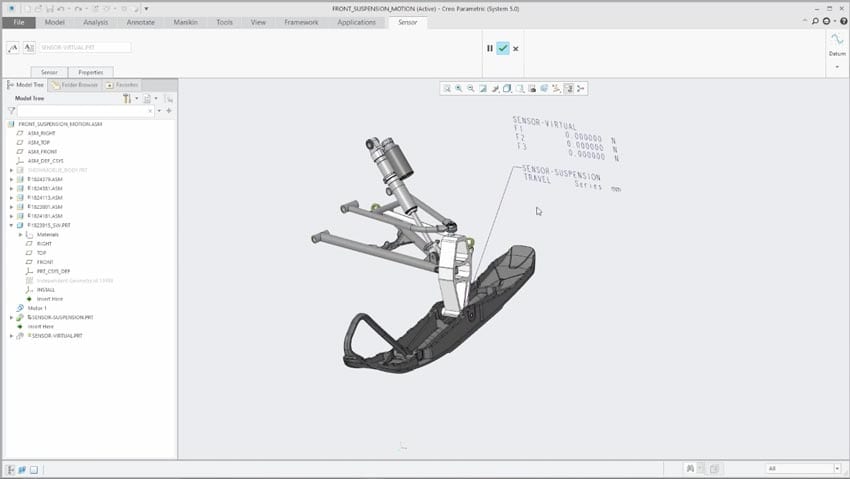
Creo Product Insight allows you to validate design assumptions using real-world data from the field directly in Creo’s simulation and analysis tools. Using this extension also decreases your reliance on building prototypes because it gives you live product performance and behavior.
Improving Existing and Next-Generation Product Designs
The absence of real-world product data stunts the optimization of current and future products. If you had access to real-world data, you would be able to validate design criteria against customer usage data and mitigate risk of product failure, warranty, repair, and liability.
With Creo Product Insight and ThingWorx you can analyze field data and provide meaningful information back to engineering. Using real-world data allows you to identify opportunities for new products in the market and understand over and under engineered designs to reduce product life cycle costs.
Improving Smart Connected Product Design
The lack of specialized tools that support smart connected products puts you at risk of falling behind the digital transformation process. When sensors and a strategy to capture real-live data are disconnected from your design process there is no way to deliver the value that your customers deserve out of their products.
Creo Product Insight gives you the ability to optimize sensor replacements, choose a sensor type, and validate data capture requirement during the design process. The extension creates an integrated design process that delivers optimal value from smart connected products.
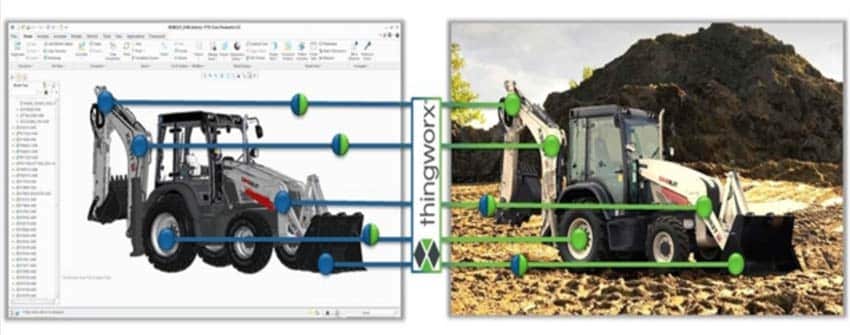
Creo Product Insight Capabilities and Benefits
Capabilities:
Benefits
- Eliminate manual workflows to use real-world sensor data in design
- Optimize products to real-world conditions
- Ensure that future products better meet the needs of customers
- Creo analyses outside of the design office
- Decrease reliance on physical prototyping
Creo Product Insight Licensing and Creo Version Capabilities
The Creo Product Insight is an add-on extension that is available for subscription licensing only. You do not need ThingWorx to use this extension – although using ThingWorx with it will fully optimize your results.
“Physical” Sensors – Creo 4 (M020):
- Easily define and place ‘measure’ sensors by adding physical sensors to Creo Assemblies
- New Instrumented sub-type to protect reused/released design data
- Associated parameter and input definitions and associated calculations
- Define (physical) calculating sensors (M020) to report analysis results (center of gravity, mass, area, etc.)
UX Sensors – Creo 4 (M030 & M040):
- Connection to ThingWorx to support reporting analyses results (M040)
- Run Creo analysis using Behavioral Modeling, Simulation, and Mechanism Dynamics (M040)
- Read real-world data from ThingWorx (or CSV data file) and use input variables to run analyses and report results back to data tables
“Virtual” Sensors – Creo 4 (M050):
- Specialized Virtual sensor handling – (excluded from BOM, meshing, and graphics)
- Directly connect and read sensor data from file or ThingWorx
- Use real-world sensor data to drive simulations
- Creo as a Service from ThingWorx (M050)
- Save/Export analysis results together with input values back to data file
Get live data from CAD models
Download the Creo Product Insight datasheet or watch this webinar replay to learn more and see if your organization could benefit from collecting live data directly within your CAD models. I’m willing to bet it can.
We transform the way companies design, manufacture, connect to, and service their products. To fully grasp how we assist and serve our customers, you need to understand our core organizational beliefs:
- We believe the product development process is broken.
- We believe that there is a better way to achieve business initiatives through product development processes and it all starts with learning.
This is exactly why we created the EAC Value Model. We’re a learn first organization. We focus on taking the LAMDA approach.
What is LAMDA?
The LAMDA is a basic learning cycle of lean product and process development. It literally stands for “look, ask, model, discuss, and act.” Ideologically it is a way to learn and optimize within a closed-loop learning cycle that continually looks to improve a situation by defining and improving root-cause issues.
Our LAMDA based EAC Value Model works as follows.
The first phase of the EAC Value Model: Learn
During the learn phase, our specialists take a first-hand approach with your business. This is when we learn about your business initiatives, ask open-ended questions, and gather information so we can truly understand the key drivers of your business’ success, any the root-cause of any potential areas of improvement.
Throughout this phase we take time to learn about your people, your team, your processes, your technology, and the ways of your organization.
We take an in-depth look at your business from front-office to back-office to determine the how your company can extract the most value from its interaction with EAC.
This leads us to the second phase of the EAC Value Model – The Mutually Agreed Upon Plan or M.A.P.
The second phase of the EAC Value Model: The M.A.P.
Using the knowledge acquired from our learning exercise, our team creates a unique customized M.A.P for your organization. Your M.A.P. is a Mutually Agreed Upon Plan that incorporates a multiple step strategy, with actionable steps and business cases for your organization.
This phase provides an understanding of what needs to be accomplished in order to achieve your desired results.
Throughout this process we evaluate solutions that may address your organizational needs. Wither they may be through engineering services, educational training services, product development consultations, system implementation services, software solutions; we configure a plan to fit your specific needs.
The creation of the M.A.P. provides a clear path to value for your organization. It holds everyone accountable for the actions needed to solve business problems and tackle initiatives.
Once we have created your mutually agreed upon plan, the implementation phase begins.
The third phase of the EAC Value Model: Implementation
During the implementation phase we put the M.A.P. into action. This is where our teams move your solution from the developmental stage into production.
You could also refer to this stage as ‘deployment’, ‘go live’, ‘roll-out, or even ‘installation’.
The tasks performed during this phase might include installing or implementing CAD, Windchill, Industrial Automation, IoT or any number of other systems. Perhaps your M.A.P. incorporated training programs for your current teams or additional services for product information. No matter what your plan includes, our team works with you to provide any service, system, or additional skill necessary to achieve your desired results.
Throughout this phase our focus remains on helping your organization become a smart, connected enterprise.
The fourth phase of the EAC Value Model: The Score Card
This is the phase that sets EAC apart. Once we have implemented your solution(s), we never lose focus on gathering feedback on how we did, how a solution is working, or whether the desired outcome or return on investment is being realized…
Remember, our overall goal is to build a long-term relationship with your organization. We feel the best way to do this is by making sure you achieve the success your company needs.
Our business is built around the way your company designs, manufactures, services and connects your products and we recognize, its’ happy customers like you who keep us in business!
With the help of our EAC Score card, we obtain your feedback on how we can continue to help your organization grow.
Our dream for your organization is to create a smart connected enterprise where you have the ability to connect to your products, your shop floor, and know your predictive downtime before it even happens. We make it our priority to help your organization achieve more than you had had imagined.
It’s finally here, the next big thing-Augmented Reality (AR) AR is finally moving from ‘a neat idea’ to ‘a necessary tool.’
Like any new technology, AR has gone through its awkward teenage years; clumsy, hasn’t grown into its ears, and doesn’t quite know what it wants to do with its life. It’s no different than the likes of portable computing, the smart phone, or any other modern technological marvel. (here’s a hilarious slide show of the early life of portable computing from itworld.com)
AR is finally coming into focus for many companies. People in various roles are starting to see how AR can reduce human errors, simplify the transfer of information, and provide insight to end users and managers alike. And I’m not even going to get into the endless possibilities involving customer engagement and experience. When a technology moves from video games and parlor tricks into serious applications like technical publications, assembly instructions, maintenance and support, and plant operations…it’s arrived.
Computing power and hardware has all but caught up to the demands of AR applications. Your company should either have, or be working on a strategy to take advantage of AR. If you don’t believe me, then maybe you’ll believe the Harvard Business Review. EAC Product Development Solutions is here to support your adoption of Augmented Reality and other Internet of Things (IoT) smart connected operations and product applications. Whether you’re getting a plan together, trying to obtain buy-in from the rest of your organization, selecting the right software platform, implementing a solution, or developing ‘experiences’ (that’s what AR and IoT applications are typically called); we’re here. We have teams of experts to make sure you successfully transform the way you design, manufacture, connect to, and service your products and organization.
As the leading PTC North American partner we offer our customers all of PTC’s technology solutions: ThingWorx, Windchill, Creo, Arbortext, Vuforia, Mathcad, etc. We also have a deep knowledge of the tools, applications, and configurations. This allows us to provide first-class consulting, implementation, and support services to ensure people like you are successful. Give us a call.
Evolving your BoM strategy, tools, and abilities. “EBoM vs. MBoM” transforms into “EBoM integrates with MBoM.” This integration includes associativity to one another, time saving tools, elimination of error prone manual steps & more.
Imagine eliminating the common disjointed processes, additional time, and error prone manual steps involved in the creation of downstream BoMs from Engineering into Manufacturing, Production and Service management.
Concepts & examples such as Manufacturing Bill of Materials (MBoM) are shown below, all under one system, integrated & associated, and created with a single click. Then they’re easily edited to meet downstream BoM needs.
BoM creation can be streamlined & improved by associatively creating downstream BoMs (S or M or other) and eventually, connecting them to your ERP system. For now, we’ll focus on the first step of this business transformation concept; the creation of the second, or downstream M or SBoM, starting with a simple EBoM example, created in minutes, and easily viewed & tracked.
Who should be involved in this topic at your company? Ideally, your Configuration Manager role should be leading or heavily involved in this process.
The starting point & tool is PTCs Windchill and your willingness to change & improve.
Once your CAD data is ready to check into Windchill, there is an option (check box) to auto-associate the EBoM to a downstream BoM such as an MBoM. It is a 1:1 relationship for starters. Options can branch out from here into many CM (Configuration Management) directions. Such as multi-level BoM management, uses, visualization and more.
Once created, you can manipulate & edit the default 1:1 downstream BoM to your needs; adding bulk items, manufacturing specific sub assemblies, (build throughs) even new service end items. You can also flatten out an EBoM to meet assembly or production needs. BoM items such as adhesive, lubricant, paint or coatings, packaging items, all things that typically are not on an EBoM, can and do belong on the M or SBoM.
If this fits your company’s needs? consider using Windchill’s auto-associate feature.
This article covers a couple examples. If this is not deep enough…here are even more tools to consider. Topics such as creating associated manufacturing instructions, work instructions, work plans and more. Change Management is shown as reference only, it is an optional element of Windchill for another blog.
There are many options to this topic, these are common examples that fit a lot of needs and is considered a starting point.
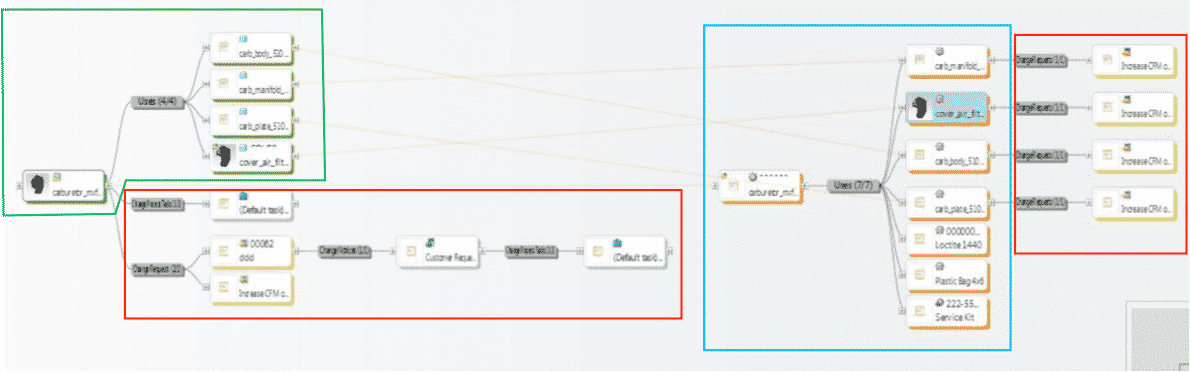
1st example shows all BoM & change components all connected in one system vs. manually done in silo fashion, which is industry’s most common method today. These examples are shown in PTCs Windchill reference viewer tool, which ties all related objects into view for easy visibility with just a few clicks.
- 1. EBoM structure (highlighted in green)
- 2. Change requests, notices and tasks (highlighted in red)
- 3. MBoM structure (highlighted in blue) with their own, or connected Change Management Requests, Notices & Tasks
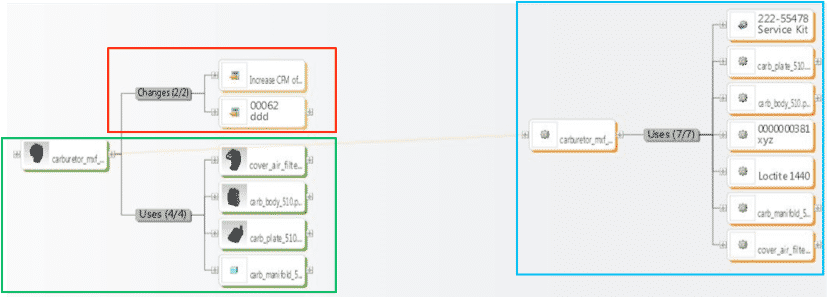
2ndexample shows an EBoM, SBoM (Service Kit in this example), with a saleable end item service kit, as well as components for service or manufacturing BoMs. It also shows Changes, these can also be created, edited, routed, approved or rejected, and even include the SBoM if need be.
Please connect with EAC to learn more, to discover your company’s transformation opportunities with an assessment, maybe see a demo, or attend a webinar. The goal is to help your company transform how you design, manufacture, connect to and service your products.
Designing a product without integrating simulation into your workflow is like giving a concert but never rehearsing. Why would you do that?
Top Performing organizations meet cost targets, remain on spending plans, and beat their due dates. One way they accomplish these objectives is by utilizing simulation tools to empower their organizations. Here’s 10 ways simulation will put you ahead.
1. Simulation software = better design decisions
Simulation tools enable engineers to have better insights throughout the design process.
For example, with the use of simulation engineers can conduct sensitivity studies, analyze trade-offs, remove excess materials and even evaluate motion envelopes.
By using simulation during concept design, engineers are able to explore and consider more options.
These options permit engineers to see the influences and effects of different design guidelines and limitations.
Testing many conditions, simulation software allows engineers to narrow down choices for the best concept.
This is how engineers are able to make better, highly informed design decisions.
2. Simulation helps avoid over engineering
By simulating your designs in a variety of environments, you can easily determine what is necessary within your design and what is not.
This helps engineers eliminate excess materials, and ultimately create better products.
3. With Simulation software, you find problems earlier (while they’re still cheap to fix)
Engineering simulation software helps organizations discover hidden interactions that can cause big problems.
How? It’s simple.
If the materials you’re using to build and design a product can’t perform under stress, you can find out early in the design process.
This helps your design team get it right the first time.
4. Simulation tools improve product quality
Simulation tools enable engineers to analyze and validate the performance of 3D virtual prototypes before the part itself is created.
With the ability to validate and test designs early in the design process, engineers are able to create and evaluate more concepts and ideas within allotted time frames.
This means more ideas, more designs, better quality and ultimately a better product.
5. Simulation software improves product reliability
With simulation software, results are accurate and reliable and can be easily calculated with very little input from engineers.
By using simulation-driven design to optimize product performance, quality and durability- you can be sure that your is more than reliable.
6. Simulation tools cut product development time
Organizations are able to reduce product development time with simulation tools because less time is needed for physical testing, fixing late problems, and rework.
When design engineers know how to run simulations, they understand the requirements for the analysis model. By taking these requirements into consideration as they design, model, and build products, the analysis becomes easier and takes less time to prepare.
7. Innovation is increased with simulation
With the help of simulation tools, engineers can also be more innovative.
Time-savings allotted from simulation and virtual prototypes enable design engineers to evaluate more design iterations.
8. Simulation helps you get to market faster
Simulation tools help streamline product development activities by enabling concurrent design and analysis.
How? It’s simple.
With simulation, the analysis process is faster. For instance, you can forget any reliance on 3rd parties for analysis because you are able to now do it in-house.
By identifying and eliminating errors early in the design process you will resolve errors early, eliminating late-stage changes and tedious rework. This will also greatly speed up your processes.
Simulation tools empower design engineers to make better design decisions.
Better design decisions ultimately produce more competitive products that cost less and get to market faster.
9. In the long run, simulation tools save costs
Simulation helps engineers make better design decisions at much less cost because they can subject virtual models to real-world forces.
By using fewer prototypes and focusing simulation on areas of high sensitivity and fatigue, an organization can save time and money.
For example, engineers can reduce product costs by optimizing designs to meet multiple objectives, such as maintaining a product’s strength while reducing its weight.
This is exactly how the use of analysis and early optimization to properly size geometry can reduce material costs.
Aside from material costs, how do product failures, warranty, and repair cost impact company profits? Tremendously.
Using simulation tools organizations can avoid costly recalls and reduce after-market service, warranty, and repair costs.
It’s easy to see how simulation tools will save you money simply by eliminating the need for project re-work, prototyping, and over-engineering
10. More competitive products
Simulation software provides engineers with additional insight, which leads to better design decisions and product optimization.
By using simulation, design engineers are able to develop higher quality products that are easily differentiated in the market.
The EAC Product Development Operating System is a framework that is based on three attributes of the product development system: that it is a competitive system; that its operation requires team-based participation from a broad range of contributors across the organization; and that it changes, evolves or decays, over time.
Many product developers have limited direct contact with their customers or their marketplace and lose sight of the competitive nature of their work. The rows of the PDOS matrix represent the three elements of a competitive system in the context of Product Development. Companies that look to capture the benefit of a competitive advantage from their product development competency cannot do so, without also addressing the needs and requirements of competitive systems.
The concept of teamwork in Product Development is well recognized and valued as a key to effective and efficient operation. Many will immediately think of the cross functional team that executes a project in adherence to an organization’s product development process. But as our model takes a systems view of which the process is a constituent element, our conception of the system team is higher level with the project team just one element of it. Product development system excellence is dependent upon individuals and teams in each hierarchical tier of the organization. These are responsible for supplying input to other subsystem elements of the model essential to these other subsystems’ effective operation. Our model represents this system team element as the columns of the PDOS matrix. These pillars of the system are labeled both with their functional role within the PDOS and with the tier of the organization responsible for that role.
The third attribute of our operating system is that it is dynamic. Without the investment of maintenance or improvement energy, entropy will degrade its structure and operation. On the other hand, a commitment to ongoing improvement will facilitate maturing of the system and carry it through the four levels of our maturity model. Our maturity model includes a system improvement tool that not only accelerates the rate of maturing but also damps the organizational turbulence often characteristic of transitions to a new level of maturity.
The subsystem elements of our model exist in the cells of our matrix. The relative strengths of these elements vary during progress to full maturity; at full maturity the seven elements interact in harmonic balance.
Three elements of a competitive system:
Our most visible competitive systems are sports franchises, and the keys to their success are instructive for business operation:
- Successful teams start with getting on the same page, literally. The team’s knowledge is captured in carefully guarded Playbooks and Game Plans. Everyone understanding the common goal and their role in it is a key to success. Successful, systematic businesses operate with shared goals that are captured in long term strategies, shorter term initiatives, and near term tactical plans.
- Teams invest time and energy in becoming more capable of competing well. The clearest example of this is practice, time spent working on improving the individual and collective skills that are brought to the competition. But the improvement to competence also includes improved infrastructure, equipment, anything that better positions the team to compete. Do businesses generally make this investment in planful improvement to their product development competency with the mind’s eye on the competitive nature of product development?
- And finally there is the competition itself. For teams the competition is head to head, and the metric is clear and clearly displayed on a scoreboard. In product development, the competing occurs in the execution of a program or project. The ultimate metric for product development is its productivity, total value created against the total investment made in creating this value. Execution of a project is the game, execution of the portfolio’s roadmap is the season. The ultimate competitive nature of product development is frequently lost in the common check-box nature of administrative project management.

The rows of the PDOS matrix:
In the EAC Product Development Operating System model, the rows represent the three elements of a competitive system. The Information row establishes the knowledge that must be shared – strategy, initiatives, tactics, process workflows – among all product development team members to create common goals and unify efforts. The Preparation row focuses on the improvement efforts that raise the level of corporate competence. And the Project row is where it all comes together, where we execute the game plan and compete.
Pillars of the System:
The columns of our system represent the pillars of the PDOS. Each pillar has two identifiers; the Product Development sub-team associated with that pillar and the focus of the contributing work done by that sub-team within that pillar.
Knowledge Base:
Knowledge is the Value currency of Product Development, and the PD Knowledge Base supports and glues together the other PD operational subsystems. The PD Information System, beyond housing data and information that serve as the building blocks of PD knowledge, also holds standards, transactional processes’ workflow, and functional tacit knowledge shared between project teammates. PLM has emerged as the critical PDIS tool.
Strategic Planning:
The work that culminates with a successful new product being delivered to market initiates with the development of a Strategic Plan. The compass heading provided by the plan informs decision making throughout the organization, including within the other PDOS subsystems. Critical decisions regarding the investments in the development of core and other competencies, as well as of new products align to the strategy.
Innovation (New Knowledge):
The Innovation subsystem elevates the competitive capability of the organization, its competences. It creates new knowledge in the form of disruptive technologies and novel methods of applying current technologies. It focuses on challenging all existing organizational standards, looking to continuously improve how it operates, and to compete in the marketplace from a position of greater strength and competitive advantage.
Expert Workforce Development:
In any competitive venue, it is understood that success ultimately relies on having great players. The competitive performance of your players is developed outside of the bounds of the competition itself. The intention of, commitment to and execution of investing in all of your product-development-critical subject matter experts – your assets –not only directly results in a more competitive team, but facilitates the recruitment of additional skilled players.
Investment Strategy:
The actual marketplace competition fulfilled by product development begins with strategic decisions about how to execute the product roadmap and elaborate the product portfolio. The informed decisions that lead to the significant investments incurred by product development create both the range and limits on profitability and corporate growth over the mid-range future. This late maturing subsystem determines the level at which you’ll compete.
Knowledge Based Decision Making:
The Knowledge Based Decision Making subsystem is the Product Development sibling to the executive function’s Fact Based Decision Making. While KBDM permeates successful Product Development organizations, in the actual competitive venue of development projects, the critical decisions that are captured as the product Concept are informed by pre-existing and newly generated knowledge of the marketplace and of corporate capabilities.
Project Execution:
The Project Execution subsystem is the part of the Product Development System that in the most narrow of views is seen as Product Development. The realization of the expanded view of the Product Development System does not diminish the critical importance of execution. Supported by new execution paradigms and product development specific information technology tools, longed for improvements in project predictability and reliability are now being achieved.
Tiers of the Organization:
Each of the three tiers in the organizational hierarchy – the executive, the managerial, and the individual functional specialist tiers – makes critical contributions to the effective functioning of a fully developed product development system.
Functional Roles within the PDOS:
The Product Development System Team comprises members in the executive, managerial, and individual subject matter layers of the organization. Each tier of the organization contributes to the effectivity of the system:
Executives set strategic direction, including the investment strategy for product development.
Directors and managers are guardians of critical product development knowledge and responsible for seeing that the right knowledge is available to the right individuals at the right time.
The functional specialists, subject matter experts generate new knowledge and use this and pre-existing knowledge in the execution of product development projects.
Maturity Model:
The EAC Maturity Model is a four level model that distinguishes the degree of structure and organization in the product development system at different periods in the evolution of the competency. The four maturity levels are:
- Tribal & Heroic
- Silo’ed
- Systematic
- Intelligent (self-managing)
System Improvement Tool:
EAC recognizes the value to both the rate of maturing and the ultimate level of maturity that is provided by a well ingrained root-cause problem solving system. The best of these are based on the PDCA cycle, also known as the Deming Cycle. Developed at Bell Labs in the early 20thcentury, and introduced to Japan in the wake of World War II, PDCA played a significant role in the rapid recovery and rise of Japanese industry. A particular version of PDCA was developed by Allen Ward, modeled on the way PDCA is executed at Toyota, and tailored by Ward to suit the way Americans prefer to work.
